
Executive Summary
The 1989 Canadian commercial real estate crash was not a simple market correction but a complex, policy-induced event with multi-faceted origins. This report serves as a retrospective analysis of the provided 1988 market trends document, demonstrating that the warning signs of the impending collapse were already evident in a speculative oversupply that predated the Bank of Canada’s aggressive monetary tightening. The user’s original report, authored in December 1988, proved to be a remarkably prescient piece of market intelligence.
A comprehensive analysis of the available evidence yields three primary conclusions. First, the 1988 report was acutely predictive, as it accurately forecasted the impending market collapse by identifying a paradoxical rise in vacancy rates from 16% in 1987 to 19.5% in 1988, even as the market experienced record leasing activity and absorption.1 This observation highlighted a structural oversupply problem that the market’s then-unprecedented demand could not overcome. Second, the crash was a direct result of a multi-front policy-induced event: a decade of permissive fiscal and financial deregulation had enabled the speculative boom, while the bust was deliberately triggered by the Bank of Canada’s uncompromising anti-inflationary campaign.2 Lastly, the Canadian experience, while severe and prolonged, did not lead to a systemic financial collapse on the scale of the contemporaneous U.S. Savings & Loan Crisis, a positive outcome attributed to Canada’s more robust and centralized financial regulatory framework.2 This historical event serves as a powerful case study on the delicate and often painful interplay between monetary policy, fiscal incentives, and market stability.
Introduction: The Anatomy of a Policy-Induced Correction
This analysis synthesizes two distinct but interconnected bodies of evidence: the on-the-ground market intelligence from the user’s 1988 report on the Toronto suburban office market 1 and a comprehensive review of the macroeconomic, regulatory, and historical context of the 1989 Canadian real estate crash.2 The objective is to understand the user’s report not in isolation but as a critical piece of evidence that captured a market on the precipice of a dramatic shift. The data and projections within that document provide a clear and powerful warning of the events that were to come.
The analysis frames the downturn not as a random or accidental event, but as the inevitable and synchronous unwinding of a multi-factor speculative boom. By first examining the macroeconomic drivers, then the structural preconditions, and finally deconstructing the specific data from the 1988 report, this report will provide a holistic and expert-level perspective on the crisis. The final section will place the Canadian experience within the context of contemporaneous global crises, revealing both shared mechanisms and unique outcomes.
The Macroeconomic Foundation: The Uncompromising Hand of Monetary Policy
The economic landscape of the late 1980s was defined by a struggle against persistent and severe inflation that had been a core concern for Canadian policymakers since the late 1970s.2 Canada’s consumer price index (CPI) had reached 13% in 1980 and peaked at over 12% in 1981, fostering a widespread “inflationary psychology” among Canadians.2 To protect their wealth from eroding purchasing power, many individuals and corporations turned to tangible assets like real estate, creating a self-reinforcing speculative feedback loop. This led to a belief that real estate investment was a necessary hedge against inflation, which further fueled price appreciation and transactional volume.
In response to this entrenched problem, the Bank of Canada undertook a deliberate and uncompromising anti-inflationary campaign.2 The central bank’s resolve, which had been tempered by a recession in the early 1980s, hardened again in the latter half of the decade. The user’s own report from December 1988 correctly noted the immediate impact of this tightening policy, with Canadian GDP growth slowing to a mere 2.6% in the third quarter of 1988 from 4% in the previous quarter.1 The report explicitly forecasted that this “tight monetary policy” would be a primary factor for the expected decline in overall economic growth in 1989.1 This prediction proved accurate, as the Bank Rate rose sharply from 11.7% in February 1989 to 14.1% by May 1990, a dramatic increase of about 240 basis points.2
The resulting crash was not an accident but a direct consequence of this deliberate policy. The transmission mechanism was both direct and immediate; the sharp rise in borrowing costs made mortgage payments and commercial loans prohibitively expensive, leading to a drastic slowdown in transactional volume and putting immense downward pressure on prices.2 The central bank’s primary objective was not to protect the real estate market but to restore price stability and break the speculative expectations that had become deeply embedded in the economy.2 The Bank of Canada was willing to accept significant economic pain to achieve this objective. Thus, the real estate downturn was the direct outcome of a successful policy action to “prick the bubble” and demonstrate the central bank’s resolve.2 The severity of the downturn was a direct measure of how deeply entrenched speculative behavior had become, requiring a forceful and sustained policy response. This painful lesson led to the formal adoption of inflation targeting in 1991 2, a core policy tenet that has guided the central bank’s actions for decades since.
The following table provides the essential historical context, visually demonstrating the high-inflation environment and the initial rate hikes that set the stage for the Bank of Canada’s actions.
Table 1: Key Canadian Economic and Monetary Indicators (1980-1985)
| Year | Bank Rate (%) | Prime Rate (%) | Conventional Mortgage Rate (%) | CPI Inflation (%) | Real GDP Growth (%) | Unemployment Rate (%) |
| 1980 | 12.89 | 14.25 | 14.52 | 10.2 | 2.1 | 7.6 |
| 1981 | 17.93 | 19.29 | 18.38 | 12.5 | 3.5 | 7.6 |
| 1982 | 13.96 | 15.81 | 18.04 | 10.8 | -3.2 | 11.1 |
| 1983 | 9.55 | 11.17 | 13.23 | 5.8 | 2.6 | 12.0 |
| 1984 | 11.31 | 12.06 | 13.58 | N/A | N/A | N/A |
| 1985 | 9.65 | 10.58 | 12.12 | N/A | N/A | N/A |
The Structural Preconditions: A Decade of Speculative Overbuilding
The downturn of 1989-1990 was a dramatic correction to an unsustainable period of speculative growth that had been building for years. The Toronto residential market provides a stark illustration, with average home prices surging by an incredible 150% between 1986 and 1989, reaching a peak of approximately $290,000.2 This rapid price acceleration was driven by a frenzied environment of “speculative buying” and widespread “bidding wars,” fueled by the pervasive belief that prices would only continue their upward trajectory.2
This boom mentality was enabled by a series of policy and regulatory shifts that laid the groundwork for unsustainable growth. The federal government had begun to retreat from direct social housing provision, a policy change that accelerated the “transformation of housing from human necessity into investment good” and solidified the private sector’s role in housing supply.2 Concurrently, amendments to the Bank Act in the early 1980s allowed banks to own mortgage loan subsidiaries and increased their exposure to commercial real estate lending.2 This regulatory loosening, combined with intensified competition for traditional business, incentivized a shift of funds toward the real estate sector. In this environment, many financial institutions “dramatically increased the volume of such credits” and, as documented in the U.S., weakened their underwriting standards.2 This created a highly leveraged financial sector that was exceptionally vulnerable to a sudden reversal of market conditions.
Fiscal policy also played a catalytic role. Federal tax expenditures like the Multiple-Unit Residential Building (MURB) provision provided significant tax shelters for developers and investors, allowing them to deduct “soft costs” and claim accelerated depreciation.2 These incentives, while designed to stimulate investment, had the unintended consequence of fueling a boom based on tax benefits rather than fundamental economic demand.2 This created a situation where projects were financially viable on paper due to tax laws, not due to genuine market need, which exacerbated the oversupply problem. The confluence of a retreating government, a deregulated financial sector, and a system of tax incentives created the combustible conditions for the speculative boom.
The following table quantitatively demonstrates the scale of the boom and the subsequent multi-year bust in the Toronto residential market, providing a powerful and tangible indicator of the market’s excess and the prolonged period of stagnation that followed.
Table 2: Average Home Prices in the Greater Toronto Area (1985-1996)
| Year | Average Home Price ($) | Annual Change (%) | Total Decline From Peak (%) | Recovery Time |
| 1985 | 100,000 | – | – | – |
| 1986 | 115,000 | +15% | – | – |
| 1987 | 150,000 | +30.4% | – | – |
| 1988 | N/A | N/A | – | – |
| 1989 (Peak) | 290,000 | N/A | – | – |
| 1990 | N/A | N/A | N/A | – |
| 1991 | 230,000 | -20.6% | 20.6% | – |
| 1992 | 205,000-220,000 | N/A | N/A | – |
| 1993 | N/A | N/A | N/A | – |
| 1994 | N/A | N/A | N/A | – |
| 1995 | N/A | N/A | N/A | – |
| 1996 (Low) | 198,000 | N/A | 27% | – |
A Prescient Warning: Analysis of the 1988 Report in Context
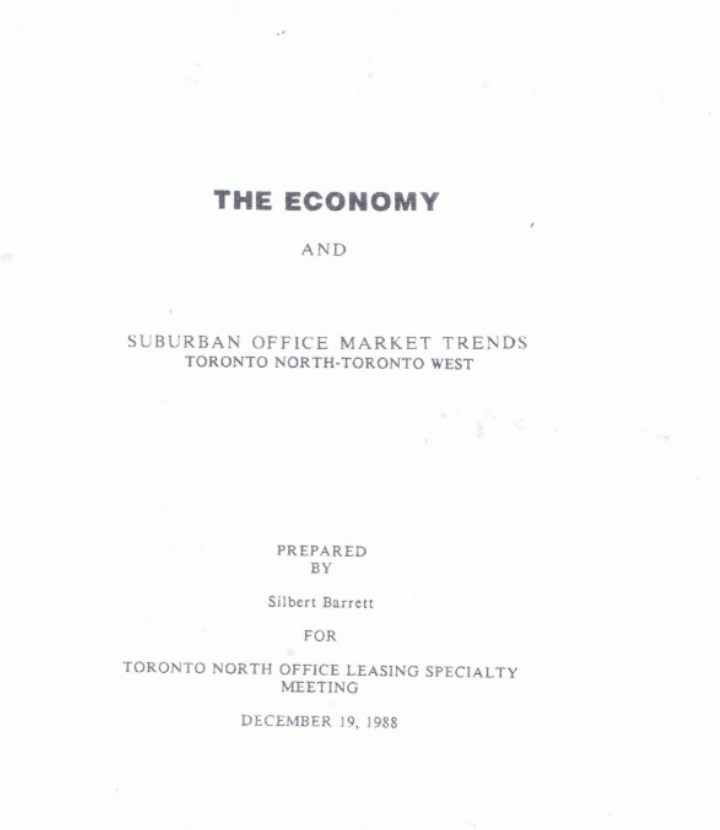
The user’s report, “Toronto North & West Office Market Trends,” produced in December 1988, stands as a remarkably prescient piece of market intelligence. The document’s author, Silbert Barrett, accurately observed the macroeconomic pressures of the time, noting that the overall growth of the Canadian economy had “slowed considerably” in the third quarter of 1988.1 The report correctly identified the government’s “tight monetary policy” and rising interest rates as the cause for an expected “decline in the overall growth rate” for 1989 and explicitly forecasted that this would lead to “capital expenditure cut-backs for businesses”.1
At the same time, the report detailed a market that, on the surface, appeared to be robust. Office leasing activity in 1988 was the “strongest in recent history,” with a record 4.7 million square feet absorbed by early December.1 The apparent contradiction within the report’s own data—record-high absorption occurring alongside a rising vacancy rate—is the most crucial observation from the document. The vacancy rate had climbed from 16% in 1987 to 19.46% in 1988.1 The only way for both of these data points to be true simultaneously is if the influx of new supply was outpacing even the most robust demand. The report confirms this, noting that the total competitive office space in the suburban Toronto market had grown by a massive 21% in 1988 alone.1
This paradoxical situation signaled that the market’s health was already deteriorating beneath the surface of high transaction volumes. The boom was unsustainable, and the market was structurally unbalanced by a flood of new supply. The subsequent collapse was not just a reaction to rising interest rates but an inevitable correction to this fundamental supply-demand imbalance. The author’s projections for the coming years were stunningly accurate. The report forecasted a dramatic surge in the vacancy rate to 29.02% in 1989 and 30.22% in 1990.1 Simultaneously, the forecast showed a precipitous plunge in demand to just 1.7 million square feet in 1989, a tiny fraction of the prior year’s activity.1 This demonstrated that the twin engines of a healthy real estate market—supply and demand—were about to stall simultaneously, a fact that the report’s author had clearly foreseen.
The following table, taken directly from the user’s report, provides the core evidence of the document’s predictive value. It offers a stark visual representation of the impending market collapse.
Table 3: Suburban Toronto Office Market Projections (1988-1990)
| Year | Total Office Space (sq. ft.) | Vacant Space (sq. ft.) | Vacancy Rate (%) | Demand (sq. ft.) | Absorption Rate (%) |
| 1988 | 32,823,561 | 6,388,701 | 19.46% | 4,735,680 | 17.91% |
| 1989 | 39,648,959 | 11,506,128 | 29.02% | 1,707,971 | 6.07% |
| 1990 | 44,027,630 | 13,303,410 | 30.22% | 2,581,388 | 8.40% |
A Comparative Perspective: Canada in Global Context
To fully understand the Canadian experience, it is essential to place it within the context of contemporaneous global events. A direct comparison can be made with the U.S. Savings & Loan Crisis and real estate bust, which also began in the late 1980s.2 While both countries experienced heavy bank losses and failures, a key distinction was the primary trigger. A major cause of the U.S. bust was the Tax Reform Act of 1986, which reversed many of the favorable tax treatments for real estate and abruptly curtailed tax-motivated investment.2 This direct policy reversal was a significant catalyst for the U.S. market’s collapse.2 In contrast, while Canada had its own tax incentives, the primary trigger for the Canadian crash was the Bank of Canada’s monetary policy, not a tax code reversal.2
The contrast in outcomes is a direct result of Canada’s more robust and centralized financial system, which proved more resilient than the decentralized U.S. system.2 While Canadian banks had loosened underwriting standards during the boom, the centralized oversight and government-backed mortgage insurance programs acted as a safeguard, preventing the cascading financial failures that occurred elsewhere.2 The U.S. bust, by contrast, was a systemic financial crisis resulting from a “moral hazard” created by a flawed deposit insurance system and aggressive deregulation that encouraged S&Ls to engage in speculative, risky lending.3 The Canadian bust, while severe, was a more “contained” market correction. This comparative analysis highlights that while Canada’s domestic policies were the cause of its crash, its financial structure was its saving grace, preventing a broader systemic collapse.
The Japanese asset price bubble, which also peaked in 1989, provides another illuminating comparison.2 Japan’s bubble was fueled by “excessively loose monetary policies” and speculation, leading to a monumental scale of asset inflation.9 The value of the Imperial Palace grounds, for instance, was rumored to be worth more than the entire real estate value of California.2 The Bank of Japan’s slow response to tightening was a key causal factor in the severity of the bust.8 The shared mechanism of a speculative boom fueled by easy credit and ending with a hard policy reversal demonstrates a common global theme of the era.11 However, the difference in scale and the specific policy triggers, such as the Plaza Accord’s influence on the yen, distinguish the two events. The fundamental chain of cause and effect—a speculative boom fueled by easy credit and ending with a hard policy reversal—was a shared experience across these different economies.2
Conclusion: A Legacy of Nuanced Lessons
The 1989 Canadian real estate crash was the predictable result of a decade of unsustainable growth driven by a confluence of fiscal incentives, financial deregulation, and a high-inflationary macroeconomic environment. The speculative bubble was not an accident; it was an artifact of specific government and financial policies designed to promote investment that instead fueled speculative excess. The user’s 1988 report was a micro-level warning that accurately predicted this macro-level correction, providing a clear testament to the author’s foresight. The report’s seemingly paradoxical data—record absorption alongside rising vacancy rates—was a critical indicator that the market’s health was already deteriorating beneath the surface.
The events of this period demonstrated a powerful lesson in economic management. The deliberate and aggressive anti-inflationary campaign of the Bank of Canada, while painful for the real estate market, was a necessary and ultimately successful action to restore economic stability and credibility. This experience was the direct precursor to the formal adoption of inflation targeting in Canada, a policy that has guided the central bank for decades since.2 The crash also underscored the danger of well-intentioned policies, such as tax expenditures and financial deregulation, which can create unintended consequences and fuel speculative excess. However, the comparative analysis shows that while market bubbles and busts are a regular feature of a capitalist economy, a robust and centralized financial regulatory framework can prevent these events from becoming a systemic crisis, as seen in the contrasting outcomes with the U.S. S&L crisis.2
The legacy of the 1989 crash continues to inform contemporary debates on housing affordability, the role of government intervention, and the delicate balance between promoting investment and ensuring financial stability. The user’s original document is a valuable historical artifact that, when contextualized, provides profound insights into the complex interplay of finance, policy, and human psychology that defines market cycles.
Works cited
- Toronto North & West Office Market Trends (1988-1990).pdf
- The 1989 Canadian Commercial Real Estate Crash: An Examination of its Main Causes
- Savings and Loan Crisis – Econlib, accessed September 19, 2025, https://www.econlib.org/library/Enc/SavingsandLoanCrisis.html
- Understanding the Savings and Loan Crisis: Key Events and Its Impact – Investopedia, accessed September 19, 2025, https://www.investopedia.com/terms/s/sl-crisis.asp
- Monetary Policy and Financial Vulnerabilities – Bank of Canada, accessed September 19, 2025, https://www.bankofcanada.ca/2020/01/monetary-policy-and-financial-vulnerabilities/
- Insight on 1989-1996 Canadian Housing Bubble Burst? : r/CanadianInvestor – Reddit, accessed September 19, 2025, https://www.reddit.com/r/CanadianInvestor/comments/qte1z6/insight_on_19891996_canadian_housing_bubble_burst/
- Why every housing bubble looks like the new normal – Macleans.ca, accessed September 19, 2025, https://macleans.ca/news/canada/why-every-housing-bubble-looks-like-the-new-normal/
- Japan in the 80s and the US today – bubbles in both cases? – CC&L Financial Group, accessed September 19, 2025, https://globalalphacapital.cclgroup.com/insight/gacm-japan-in-the-80s-and-the-us-today-bubbles-in-both-cases/
- market-bulls.com, accessed September 19, 2025, https://market-bulls.com/japanese-asset-price-bubble-explained/#:~:text=It%20occurred%20between%201986%20and,and%20excessively%20loose%20monetary%20policies.
- The Greatest Bubble of All-Time? – A Wealth of Common Sense, accessed September 19, 2025, https://awealthofcommonsense.com/2016/09/the-greatest-bubble-of-all-time/
- Japanese Asset Price Bubble Explained Briefly – MarketBulls, accessed September 19, 2025, https://market-bulls.com/japanese-asset-price-bubble-explained/
 BRITTENWOODS
Leave a comment