Introduction: Deconstructing the ‘From Nothing to Everything’ Narrative
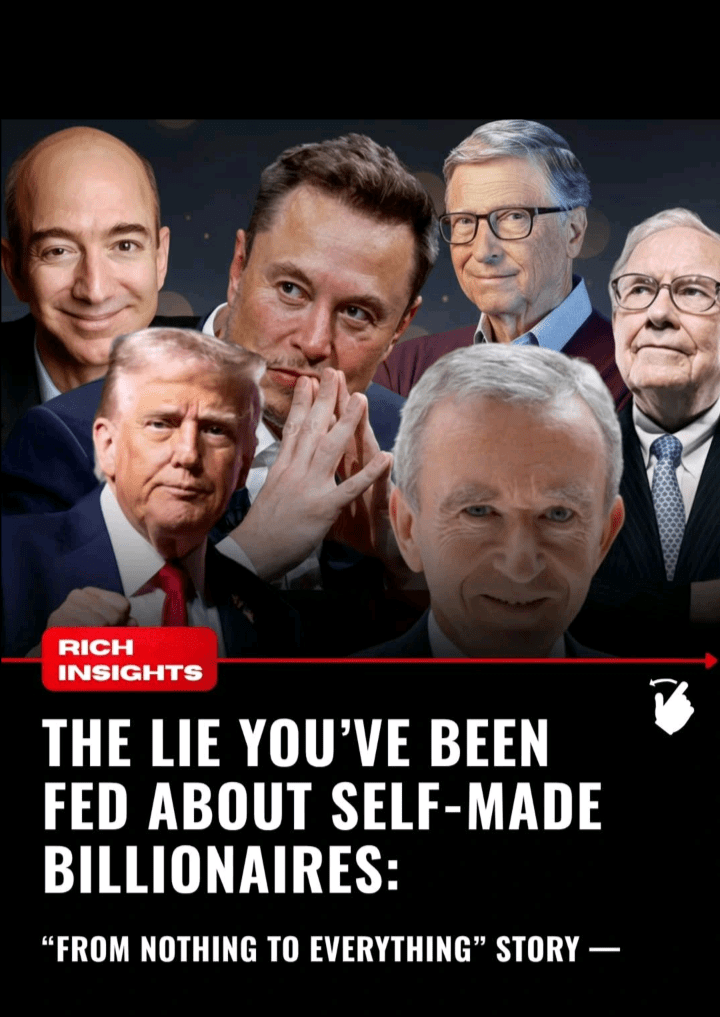
The narrative of the “self-made” billionaire is one of the most potent and enduring mythologies in modern capitalism. It is a story of singular vision, relentless discipline, and heroic struggle against insurmountable odds—a narrative that posits the accumulation of extraordinary wealth as the ultimate validation of individual merit. This “from nothing to everything” arc, celebrated in media and lionized in business culture, suggests that the path to the highest echelons of the global economy is, in principle, open to anyone with sufficient genius and grit. However, a critical examination of the origins of today’s most iconic billionaires reveals a more complex and structured reality. The images that prompted this investigation present a powerful counter-narrative: that for many of these figures, the game was “tilted before the first move”. This report undertakes a detailed analysis of this claim, moving beyond simplistic myth-making to reveal the foundational advantages that shaped the careers of six of the world’s most famous billionaires: Jeff Bezos, Bill Gates, Donald Trump, Bernard Arnault, Elon Musk, and Warren Buffett.
The objective of this report is not to dismiss the formidable talent, ambition, and strategic acumen these individuals undoubtedly possess. Rather, it is to provide a rigorous, evidence-based evaluation of the unacknowledged “starting line” privileges that functioned as a critical accelerant for their success. These advantages can be categorized into three distinct but interconnected forms of capital:
- Financial Capital: This encompasses direct access to monetary resources, including significant seed funding from family, multi-generational inherited wealth, and family-financed bailouts that mitigate the risk of catastrophic failure. This form of capital provides a crucial runway for experimentation and growth, a luxury unavailable to entrepreneurs who must rely on conventional, and often unforgiving, sources of funding.
- Social Capital: This refers to the value derived from elite social networks. Access to influential figures in business, finance, and politics can open doors to pivotal opportunities, partnerships, and contracts that are inaccessible through merit alone. It is the currency of connections, turning a cold call into a warm introduction and transforming a fledgling venture into a validated enterprise.
- Educational Capital: This extends beyond mere knowledge to include the credentials, networks, and cultural signaling conferred by attendance at elite institutions. An Ivy League or equivalent degree serves as a powerful heuristic for investors and partners, signifying a level of competence and belonging that can dramatically shorten the path to credibility and trust in high-stakes environments.
By examining the interplay of these three forms of capital in the origin stories of each billionaire, this report will demonstrate a consistent pattern. In each case, a potent combination of these advantages provided a foundation upon which their personal talents could be leveraged to an extraordinary degree. The popular narratives often isolate the individual from this supportive ecosystem, creating what the source material calls an “illusion” designed to “sell hope” while obscuring the structural realities of wealth accumulation.
The following table provides a summary framework for the detailed analysis in the subsequent chapters, illustrating the common architecture of privilege that underpins these disparate stories of success.
Table 1: Summary of Foundational Advantages
| Billionaire | Primary Financial Advantage | Key Social/Network Advantage | Elite Educational Institution |
| Jeff Bezos | Angel Investment from Parents (~$245,573) | Wall Street Experience (D.E. Shaw & Co.) | Princeton University |
| Bill Gates | Affluent Upbringing | Mother’s Board Connection to IBM CEO | Harvard University (attended) |
| Donald Trump | Generational Wealth (>$413M in transfers, bailouts) | Father’s Real Estate & Political Network | University of Pennsylvania (Wharton) |
| Bernard Arnault | Capital from Family Business (~$15M) | Established Family Business (Ferret-Savinel) | École Polytechnique |
| Elon Musk | Wealthy Family in South Africa (Disputed funding sources) | University & Early Tech Scene Connections | University of Pennsylvania (Wharton) |
| Warren Buffett | Affluent Upbringing | Father was a U.S. Congressman & Stockbroker | Columbia Business School |
This report will proceed with a forensic examination of each case study, validating the claims made in the source images and constructing a nuanced account of how privilege and personal agency combined to create some of the largest fortunes in human history. The ultimate aim is to move beyond the mythology and toward a more sober understanding of the pathways to extreme wealth.
Chapter 1: Jeff Bezos – The Garage Myth and the Bank of Mom and Dad
The founding of Amazon is a cornerstone of Silicon Valley lore, often distilled into the potent image of a visionary entrepreneur starting with nothing but an idea in a humble garage. This narrative emphasizes individual ingenuity and foresight, positioning Jeff Bezos as a quintessential “self-made” man who saw the future of commerce and willed it into existence. While his vision was undeniably transformative, a closer examination reveals that the garage had a very strong financial foundation, built not with venture capital, but with a substantial and crucial investment from his parents.
The Truth: Capital Meets Competence
The claim that Bezos’s parents provided one of the largest early investments in tech history is well-documented and fundamentally accurate. In 1995, Jackie and Mike Bezos invested $245,573 in their son’s fledgling e-commerce venture. Other accounts place the estimated total around $300,000. This was not a token sum from a wealthy family dabbling in their son’s hobby; it was a significant capital injection that may have constituted a large portion of their life savings. Mike Bezos, Jeff’s adoptive father, was a petroleum engineer for Exxon, a career that afforded the family a comfortable, upper-middle-class life and the ability to make such a high-risk investment.
This financial capital was deployed by an individual already equipped with elite educational and professional capital. The assertion of “Ivy-League training + Wall Street mentors” is central to understanding Bezos’s preparedness. He graduated summa cum laude from Princeton University in 1986 with dual degrees in electrical engineering and computer science. This academic foundation was followed by a rapid ascent on Wall Street. He worked at several financial firms before landing at the quantitative hedge fund D.E. Shaw & Co., where he became the firm’s youngest senior vice president by 1990, at the age of 26.
It was from this vantage point within the financial industry that Bezos identified the market opportunity that would become Amazon. He observed that internet usage was growing at a staggering 2,300% annually and conceived of an online bookstore as the first step into a vast new world of e-commerce. He did not stumble upon this idea in a garage; he formulated it as a seasoned financial analyst with access to market data and the expertise to interpret it.
The combination of these elements—parental funding, an elite education, and high-level professional experience—creates a picture far more complex than the simple garage myth. It illustrates the principle articulated in the source image: “When capital meets competence, the climb shortens”.
Analysis: The Symbiosis of Privilege
The significance of the parental investment extends far beyond its dollar value. The fact that this substantial seed funding came from family, rather than professional venture capitalists, provided Bezos with an invaluable and unquantifiable advantage: “patient capital.” Professional investors typically demand significant equity, board representation, and a clear, often aggressive, timeline for a profitable exit. They exert pressure and influence strategy, which can be at odds with a founder’s long-term vision. Bezos’s parents, in contrast, were “betting on Jeff,” not just on a business plan. He was transparent about the risks, warning them there was a 70% chance they would lose their entire investment—a risk profile that would be untenable for most early-stage venture funds considering such a large initial check. This familial backing granted him a period of operational freedom, allowing him to build the company according to his famously long-term, customer-centric vision without the immediate pressure for profitability that would have come from outside investors. This emotional and financial support system, a form of privilege that is rarely acknowledged in founder myths, was a critical buffer against early failure.
This patient capital, however, would have been squandered without the “competence” Bezos had already acquired. His career at D.E. Shaw was not merely a job; it was an incubator where he honed the analytical skills to identify a nascent market trend and develop a credible strategy to exploit it. His Princeton education provided the technical and intellectual toolkit necessary to understand the underlying technology and build the initial software. The two elements were symbiotic. His elite background—the Princeton degree and the Wall Street credentials—gave him the credibility to ask his parents for a quarter-million dollars. In turn, that capital gave him the runway to execute the plan his elite training had enabled him to formulate.
This dynamic reveals that privilege is not a singular factor but a compounding system. Educational, social, and financial advantages do not operate in isolation; they amplify one another. The Bezos origin story is not one of a man who started with nothing. It is the story of a highly competent individual whose path was dramatically accelerated by access to a rare combination of risk-tolerant capital and an elite professional network, all built upon the foundation of a world-class education. The garage was merely the final, and most mythologized, stage of a journey that began years earlier in the halls of Princeton and on the trading floors of Wall Street.
Chapter 2: Bill Gates – The Power of Proximity and a Mother’s Network
The story of Bill Gates is often framed as a triumph of precocious genius and rebellious intellect—the “dorm-room coder who changed the world” by dropping out of Harvard to pursue a singular vision. This narrative emphasizes his individual talent and coding prowess, suggesting a solitary figure whose technical skills were so profound that they inevitably reshaped the global economy. While his intellect and passion for software are undeniable, this myth conveniently omits the single most critical factor in Microsoft’s early ascent: the extraordinary social capital wielded by his mother, which secured the company’s foundational contract with IBM.
The Truth: Connections Before Code
The central claim that Bill Gates’s mother was instrumental in landing Microsoft’s first major contract is overwhelmingly supported by historical accounts. Mary Maxwell Gates was not merely a supportive parent; she was a formidable and highly influential figure in the civic and corporate life of Seattle and the nation. She served for 18 years on the University of Washington’s Board of Regents, was the first female president of United Way of King County, and sat on the corporate boards of First Interstate Bank, Pacific Northwest Bell, and others.
This network was not built from scratch. It was a product of generational privilege. Mary’s father, J.W. Maxwell (Bill’s maternal grandfather), was the president of the National City Bank in Seattle and a director of the city’s branch of the Federal Reserve Bank. Bill’s father, William H. Gates Sr., was a prominent attorney who co-founded the powerful law firm that would become Preston Gates & Ellis. The family was deeply embedded in the upper echelons of Seattle’s legal, financial, and philanthropic circles.
It was through this elite network that the pivotal connection was made. As a member of the national board of United Way of America, Mary Gates served alongside John Opel, the chairman and CEO of IBM. In 1980, as IBM was secretly developing its personal computer, she mentioned her son’s small software company to Opel. This conversation occurred at a crucial juncture. IBM’s negotiations with another software company, Digital Research, to provide the PC’s operating system were faltering. According to multiple reports, when IBM executives revisited the need for an operating system, Opel recalled the conversation and identified Microsoft as “Mary Gates’ boy’s company”. This high-level endorsement from the chairman’s trusted colleague provided the opening Microsoft needed.
The assertion that “Before the code came the connections” is therefore not hyperbole, but a precise summary of events. Microsoft did not win the IBM deal because it had a superior, pre-existing product. In fact, Microsoft did not have an operating system to sell at all. After securing IBM’s interest, Gates and Paul Allen famously purchased an existing operating system known as QDOS (Quick and Dirty Operating System) from a small Seattle company for approximately $50,000, which they then adapted and rebranded as MS-DOS for IBM.
Analysis: The Compounding Effect of Privilege
The IBM contract was the inflection point that transformed Microsoft from a niche software maker into the future titan of the industry. The opportunity was generated not by a superior product or a competitive bidding process, but through the strategic deployment of social capital. This demonstrates that access to the right network at the right moment can be a far more decisive asset than technical readiness. Mary Gates’s connection did not just provide an introduction; it offered high-level validation and a crucial foot in the door at the exact moment a competitor stumbled. This was not a matter of luck, but the predictable outcome of a lifetime spent cultivating influence within the highest circles of American business.
This pivotal moment, however, was itself the culmination of a life lived within elite and resource-rich environments. The skills that made Microsoft a credible, if small, player in 1980 were themselves a product of immense privilege. Gates attended the exclusive Lakeside School in Seattle, which, thanks to the fundraising efforts of mothers like Mary Gates, was one of the very few high schools in the world to have a computer terminal in the late 1960s. This gave Gates and his co-founder Paul Allen thousands of hours of hands-on programming experience years before most university students had ever seen a computer. This rare and early access to technology was a direct result of his family’s wealth and social standing.
A clear causal chain emerges from this analysis. Generational wealth and influence provided access to an elite preparatory school. That school provided rare access to cutting-edge technology (educational capital), which allowed Gates to develop a deep and early expertise in programming. This expertise formed the basis of his first company. Finally, his family’s elite social network (social capital) provided the once-in-a-generation opportunity to leverage those skills on a global scale by securing the IBM contract. The “dorm-room coder” myth is compelling because it isolates the individual genius from this deeply embedded system of support. It focuses on the code, which Gates certainly mastered, but ignores the connections that made the code matter to the world.
Chapter 3: Donald Trump – An Empire Inherited, Not Built
Among the figures examined in this report, the narrative of Donald Trump presents the most direct and profound contradiction to the “self-made” myth. His public persona, cultivated over decades through books, television, and political campaigns, is built on the story of a brilliant dealmaker who transformed a “very small loan” of $1 million from his father into a multi-billion-dollar empire. This narrative is not merely an exaggeration but a fundamental misrepresentation of his financial origins. An exhaustive investigation by The New York Times reveals that Donald Trump did not just receive a small loan; he was the beneficiary of a massive and continuous transfer of wealth from his father, Fred Trump’s, real estate empire, a fortune that insulated him from the consequences of repeated business failures.
The Truth: A Generational Transfer of Wealth
The claim that Trump inherited “over $400 million” is a conservative summary of the findings of the Pulitzer Prize-winning 2018 New York Times investigation. Based on a trove of more than 100,000 pages of confidential tax returns and financial records, the report concluded that Donald Trump received at least the equivalent of $413 million in 2018 dollars from his father’s business empire. This flow of capital was not a one-time inheritance upon his father’s death; it began when Trump was a toddler and continued for decades. By the time he graduated from college, he was already receiving the inflation-adjusted equivalent of $1 million per year from his father.
This immense transfer of wealth was facilitated by a series of dubious and, at times, fraudulent tax schemes in which Donald Trump was an active participant. Fred and Mary Trump transferred over $1 billion to their children while paying only $52.2 million in taxes, a rate of about 5%, instead of the 55% gift and inheritance tax rate that should have applied. Key mechanisms included:
- A Sham Corporation: In 1992, the Trump children, including Donald, formed a company called All County Building Supply & Maintenance. Fred Trump would then use this company as a middleman for purchasing supplies for his buildings. He would pay All County inflated prices for items like boilers and cleaning supplies, with the markups—sometimes as high as 50%—flowing directly to his children as tax-free gifts disguised as business transactions.
- Systematic Undervaluation: The family systematically and dramatically undervalued their real estate holdings in tax filings to minimize gift and inheritance taxes. Properties declared to be worth a total of $41.4 million were sold off over the next decade for more than 16 times that amount.
Furthermore, the image’s assertion that “Bankruptcies were lessons financed by his father’s fortune” is strongly supported by the record. Fred Trump repeatedly bailed out his son’s struggling ventures. In a notable 1990 incident, when Donald Trump’s Trump’s Castle casino in Atlantic City was unable to make a bond payment, Fred sent a bookkeeper to purchase $3.35 million in casino chips with no intention of gambling—an action later deemed an illegal loan by New Jersey gaming regulators. On another occasion, to help Donald manage his debts, Fred purchased a 7.5% stake in one of his son’s condominium projects for $15.5 million, only to sell it back four years later for a mere $10,000.
Analysis: Wealth as Insulation from Consequence
The evidence overwhelmingly supports the conclusion that “He didn’t climb — he was carried”. Unlike the other individuals in this report, whose family advantages primarily served as a launchpad, Donald Trump’s inheritance functioned as a perpetual, shock-absorbing safety net. His career was marked by multiple corporate bankruptcies and business failures that would have been terminal for any entrepreneur operating without such a profound financial backstop. The ability to take enormous risks, fail spectacularly, and re-emerge with his brand and reputation as a “successful” businessman intact is a direct consequence of having access to a generational fortune that could absorb the losses.
This dynamic reveals a crucial function of extreme inherited wealth: it fundamentally alters the rules of business by removing the ultimate consequence of failure. For an ordinary entrepreneur, bankruptcy is often the end of the road. For Trump, it was a strategic tool, a “lesson” financed by his father’s empire, allowing him to shed debt and move on to the next venture. This continuous insulation from market discipline means that his business career cannot be evaluated by the same standards as that of a truly self-made individual.
The “small loan of $1 million” story is therefore more than just a factual inaccuracy; it is a calculated and essential piece of brand mythology. By drastically minimizing the scale and nature of his financial origins, Trump constructed a public persona of a maverick outsider and brilliant dealmaker who succeeded against the odds. This narrative was central to his identity on “The Apprentice” and became a cornerstone of his political appeal. The New York Times investigation demonstrates that this persona is a complete fabrication, built on the hidden foundation of inherited wealth and tax avoidance. In this case, the “self-made” myth was not just a story told about success; it was a deliberately crafted illusion that became the product itself, a brand identity sold to the public that was fundamentally at odds with the documented reality.
Chapter 4: Bernard Arnault – From Family Construction to Luxury Conglomerate
The narrative of Bernard Arnault’s rise to become the “pope of fashion” is often presented as a story of visionary genius, portraying him as the “son of an engineer who built luxury from dust”. This framing suggests a creative and entrepreneurial leap from a modest, industrial background into the rarefied world of high fashion and luxury goods. While Arnault’s strategic brilliance is beyond dispute, the “from dust” element of the myth obscures the substantial foundation upon which he built his empire: a successful family construction business that provided the initial capital and control necessary for his audacious entry into the luxury market.
The Truth: Inheritance Rebranded
The claim that Arnault’s “father owned a massive construction firm” is accurate and central to his origin story. The company, Ferret-Savinel, was a civil engineering firm founded by Arnault’s maternal grandfather, Etienne Savinel, and later run by his father, Jean Léon Arnault. It was a reputable and prosperous enterprise in Roubaix, France. After graduating from the prestigious École Polytechnique in 1971, Bernard Arnault joined the family business as an engineer.
Arnault did not simply inherit a static enterprise; he actively reshaped it. Demonstrating his early business acumen, he convinced his father to liquidate the company’s industrial construction division for 40 million French francs and pivot into the more lucrative real estate sector, focusing on holiday accommodations. Under the new name Férinel, Arnault became president of the company from 1978 to 1984, solidifying his control and growing the family’s wealth.
The pivotal moment in his career, and the one that launched his luxury empire, came in 1984. Arnault learned that the French government was seeking a buyer for the bankrupt textile conglomerate Boussac Saint-Frères. His primary interest in the sprawling, failing group was one of its crown jewels: the fashion house Christian Dior. To execute the acquisition, he put up $15 million of his own family’s money, leveraged from the Férinel real estate business, and combined it with financing from Lazard Frères to buy the entire group. Once in control, he systematically sold off most of Boussac’s other assets, including its textile and disposable diaper divisions, retaining only Christian Dior and the department store Le Bon Marché. This strategy, which involved laying off 9,000 workers, earned him the nickname “The Terminator” but quickly returned the core assets to profitability.
Analysis: Capital Redeployment and the Cornerstone Strategy
The assertion that “It wasn’t innovation – it was inheritance rebranded” captures an essential truth but misses a critical nuance. Arnault’s story is not one of starting from zero, nor is it one of passive inheritance where he simply managed an existing fortune. His unique form of entrepreneurship was based on the strategic redeployment of capital. He recognized that the substantial capital and control he inherited from a successful, albeit less glamorous, family business could be used as a weapon to acquire assets in a completely different sector—one with far greater potential for global scale, high margins, and cultural cachet.
His genius was not in inventing a new product but in his mastery of the leveraged buyout and his vision for consolidating fragmented luxury brands into a powerful conglomerate. This type of entrepreneurship—based on financial engineering and corporate raiding—is only possible for those who already possess a significant capital base. The family business provided the ante required to get into this high-stakes game.
Furthermore, Arnault’s acquisition of Boussac to secure Dior reveals a profound long-term strategy. He saw Dior not merely as a valuable brand to be polished and run, but as the “cornerstone” of a future luxury empire. Owning Dior gave him the platform, the credibility, and the cash flow to launch his next, even more audacious move: the takeover of LVMH Moët Hennessy Louis Vuitton. In 1987, he was invited to invest in the newly merged company, and by 1989, through a series of aggressive and shrewd stock purchases, he had wrested control, ousting the founding families.
The inheritance from Ferret-Savinel was therefore not the end of the story but the critical first move in a multi-decade chess game. It provided the initial financial firepower and the business experience that enabled him to acquire the foundational piece of his empire. From there, his own ambition and strategic brilliance took over. The myth of building “from dust” erases this crucial first step, ignoring the reality that the foundation of the world’s largest luxury group was laid not in a design studio, but in the balance sheets of a family construction company.
Chapter 5: Elon Musk – The Contentious Tale of Privilege and Lineage
The public persona of Elon Musk is perhaps the most carefully constructed of all the billionaires in this analysis, built around the powerful myth of the “immigrant who slept on floors and conquered Mars”. This narrative evokes a story of extreme hardship, solitary struggle, and pure intellectual willpower, positioning him as an outsider who overcame poverty to achieve the impossible. However, a detailed investigation into his origins reveals a background of significant and undisputed wealth, a privileged lineage that is often obscured by a contentious and distracting debate over a single, exotic family asset: an emerald mine.
The Truth: A Privileged Lineage
The claim that Musk’s “father owned emerald mines in Zambia” is the most explosive and controversial element of his backstory. The truth is murky and contested. Elon Musk himself has offered conflicting accounts. In a 2014 interview, he stated his father “had a share in an emerald mine in Zambia”. In recent years, however, he has vehemently denied this, calling it “the fake emerald mine thing,” dismissing it as one of his father’s “tall tales,” and offering a million Dogecoin for proof of its existence.
His father, Errol Musk, has consistently maintained that the mine was real, though he describes it not as a formal, registered company but as an informal, “under the table” operation. His account involves a chance encounter where he traded a plane for a half-stake in the output of an unregistered emerald site near Lake Tanganyika in Zambia during the 1980s. Biographer Walter Isaacson, after interviewing all parties, offers a reconciling view: Errol Musk never formally owned a mine but did run a “cloak-and-dagger” business for several years, acquiring raw emeralds from a mine owner and selling them illegally to jewelers overseas.
While the exact nature of the emerald business remains debated, what is undisputed is the Musk family’s wealth. Errol Musk was a successful consulting engineer and property developer in South Africa. He became a millionaire before the age of 30 and owned “one of the biggest houses in Pretoria,” a yacht, a private plane, and other properties. Elon himself has acknowledged that his family was wealthy during his youth. This status as an affluent, white family during the era of apartheid in South Africa is a critical and often overlooked component of his background, affording him a standard of living and a set of opportunities unavailable to the vast majority of the country’s population.
The funding for his first startup, Zip2, also contradicts the “started with nothing” narrative. While Musk has claimed he and his brother Kimbal started the company with only a few thousand dollars of their own money, other accounts, including Ashlee Vance’s biography, report that their father provided an initial $28,000. Musk later amended this, stating his father contributed about $20,000, or “10% of a ~$200k angel funding round,” at a later stage when the risk was reduced. While the amount is relatively small compared to other figures in this report, it demonstrates a level of family financial backing that is inconsistent with the “sleeping on floors” legend.
Analysis: Redefining Hardship from a Position of Privilege
The intense public fascination with the emerald mine, whether it was real, exaggerated, or a complete fabrication, serves as a powerful narrative distraction. The debate over a single, exotic source of wealth conveniently obscures the more fundamental and undeniable truth: Elon Musk was born into significant economic and social privilege. Arguing about the mine shifts the focus away from the mundane reality that his father was a successful professional who provided an upper-class upbringing. This background gave him access to early computers, a quality education, and the financial and social stability to emigrate to Canada and then the United States to attend elite universities (Queen’s University and the University of Pennsylvania). The story of the immigrant entrepreneur sleeping in the office and showering at the YMCA is a compelling anecdote of personal sacrifice, but it omits the structural advantages that made his journey possible in the first place.
This leads to a more subtle and sophisticated form of narrative construction. By all accounts, including his own, Musk’s childhood was emotionally brutal. He endured severe bullying at school and had a psychologically damaging and traumatic relationship with his father. He leverages this real and profound emotional hardship in his personal narrative. However, this narrative effectively conflates psychological suffering with economic deprivation. It is entirely possible to have a painful, traumatic childhood while simultaneously benefiting from immense economic, racial, and social privilege.
The “self-made” myth that Musk projects substitutes one form of hardship for another. It creates a relatable story of overcoming adversity that resonates with a broad audience, while eliding the economic advantages that are far more relevant to his subsequent business success. This reveals a complex dynamic where genuine personal trauma is used, consciously or not, to legitimize a story of economic struggle that is not supported by the facts. The legend of his success is thus built not just on his undeniable engineering talent and relentless drive, but also on a carefully curated story of overcoming a type of adversity that does not negate the powerful tailwinds of his privileged lineage.
Chapter 6: Warren Buffett – Born in the Halls of Wall Street
The legend of Warren Buffett, the “Oracle of Omaha,” is one of folksy wisdom, Midwestern common sense, and singular genius. The prevailing myth portrays him as a “self-taught genius who mastered markets alone,” an outsider from Nebraska who, through sheer intellect and a disciplined, value-oriented approach, consistently outsmarted the slick, pedigreed insiders of Wall Street. This narrative is appealing because it suggests that the complex world of high finance can be conquered by anyone with enough patience and intelligence, regardless of their background. The reality, however, is that while Buffett’s genius is unique, his education in the ways of capital began at birth. He did not need to break into the world of finance; he was born directly into it.
The Truth: An Immersive Financial Upbringing
The assertion that Buffett’s “father was a stockbroker & U.S. Congressman” is the factual cornerstone of his early life. Howard Homan Buffett was not just a rank-and-file broker; in 1931, at the height of the Great Depression, he founded his own investment firm, Buffett-Falk & Co., in Omaha. He was also a politically active and principled figure, serving four terms in the U.S. House of Representatives as a Republican from Nebraska.
This unique combination of professions created an environment of total immersion in finance and economics for the young Warren Buffett. His father’s business was the family business, and the dinner table conversation was a constant seminar on markets, investments, and the principles of money. This upbringing provided an unparalleled and informal education long before he ever attended a university. His interest was kindled early and nurtured directly:
- He bought his first stock at the age of 11, purchasing three shares of Cities Service Preferred for $38 apiece.
- He filed his first tax return at age 13, famously deducting $35 for the use of his bicycle on his newspaper delivery route.
- As a teenager, his father took him on a trip to New York City, which included a visit to the New York Stock Exchange, giving him a direct glimpse into the heart of American capitalism.
This deep, practical grounding was later formalized with an elite academic education. After graduating from the University of Nebraska, Buffett was accepted to Columbia Business School, specifically to study under Benjamin Graham, the legendary author of “The Intelligent Investor” and the acknowledged “father of value investing”. This mentorship provided Buffett with the rigorous intellectual framework that would become the bedrock of his entire investment philosophy. His first professional job after Columbia was working for his father’s brokerage firm.
Analysis: Privilege as an Educational and Ethical Foundation
The image’s conclusion that “He didn’t break in – he was born in” is a profoundly accurate assessment of his formative years. Buffett’s primary advantage was not a large inheritance of cash, but an inheritance of knowledge, access, and a specific worldview. This early-life immersion in the world of capital represents a form of cognitive and educational privilege. It gave him a level of financial literacy and a conceptual fluency with markets from childhood that most adults, even those with advanced business degrees, never achieve.
This head start acted as a powerful educational accelerator. By the time he arrived at Columbia to study under Benjamin Graham, he was not a novice seeking introduction. He was a deeply prepared student, already steeped in the practical realities of the stock market, ready to absorb and synthesize Graham’s advanced theoretical concepts. His subsequent genius lies in how he masterfully built upon and evolved this foundation, but the foundation itself was a direct product of his birth and upbringing. He had a multi-decade head start on mastering the “10,000 hours” of deliberate practice required for expertise in his chosen field.
Beyond the technical knowledge, Buffett inherited something less tangible but equally critical: a specific ethical framework. His father, Howard, was renowned for his staunch principles and what Warren would later call an “inner scorecard.” Howard Buffett was a man of such integrity that during his first term in Congress, he refused a pay raise, insisting he had been elected at the lower salary. Warren frequently cites this concept of an “inner scorecard”—judging oneself by one’s own standards rather than by public acclaim—as a guiding principle of his life and business.
In the world of finance, where trust is the ultimate currency, a reputation for unimpeachable integrity is an enormous long-term competitive advantage. It became the cornerstone of the Berkshire Hathaway brand, enabling partnerships and deals to be made on the basis of a handshake and attracting long-term investors who trusted his stewardship. While many analyses of Buffett’s success focus on the financial acumen he developed, this inherited ethical framework, which he transformed into a core business strategy, is an equally important, if less appreciated, form of privilege. It provided a non-financial but incredibly valuable asset that differentiated him in a notoriously cutthroat industry and was essential to his enduring success.
Conclusion: Redefining ‘Self-Made’ in the Age of Extreme Wealth
The detailed examination of these six iconic billionaires reveals a clear and consistent pattern that challenges the foundational premise of the “self-made” myth. While the specific nature of their advantages varied—from Jeff Bezos’s parental seed funding and Bill Gates’s mother’s elite network to Donald Trump’s vast inheritance and Warren Buffett’s immersive financial upbringing—the underlying structure is the same. In every case, significant, pre-existing capital in its financial, social, or educational form served as a critical prerequisite for their ascent. This capital was not a minor boost but a powerful accelerant and a crucial mitigator of risk, providing a starting line far ahead of the general population.
It is essential to reiterate that acknowledging this reality does not negate the role of individual agency. The immense drive of Bezos, the strategic ruthlessness of Gates, the acquisitive genius of Arnault, the engineering vision of Musk, and the unparalleled investment acumen of Buffett are all indispensable components of their respective stories. Their personal attributes are undeniable and were essential in converting their initial advantages into globe-spanning empires. The central finding of this report is not that privilege is a substitute for talent, but that it acts as a powerful multiplier. The talents of these individuals were applied to a set of opportunities, resources, and safety nets that are structurally unavailable to the vast majority of people. The narrative of the “self-made” man collapses when confronted with the evidence that none of these men made it on their own.
This raises a crucial question: Why does this mythology persist so powerfully in the face of contrary evidence? The answer lies in its ideological function. The “self-made” narrative is the capstone of a meritocratic ideal, suggesting that wealth and status are direct reflections of worth and effort. As the source images suggest, this story is not merely about inspiration; it is about illusion. The claim that “hope sells control” points to a deeper societal mechanism: by focusing on these exceptional and fundamentally misrepresented stories, the system encourages a belief that such outcomes are achievable for anyone through sheer force of will. This belief obscures the profound structural inequalities—in access to capital, networks, and elite education—that make such ascents nearly impossible without a privileged start. The myth encourages the public to “master their playbook” without acknowledging that the game was “tilted before the first move”.
Therefore, a more honest and analytically sound framework for understanding success is required. In the age of extreme wealth concentration, the notion of a truly “self-made” billionaire is largely a statistical anomaly, a romantic fiction. A more accurate model views extraordinary success as the product of a dynamic interplay between individual agency and structural advantage. To recognize this is not to diminish the achievements of these individuals, but rather to place them in their proper context. It allows for a more realistic understanding of economic mobility, a more critical evaluation of the stories we are told about success, and a more sober appreciation of the true nature of opportunity in the 21st-century economy. The final truth is that while these men finished the race in first place, none of them began at the common starting line.
 BRITTENWOODS
Leave a comment