1. Introduction: The Architecture of Structural Inheritance
The macroeconomic history of Jamaica between 1990 and 2025 presents a dual narrative that has long challenged conventional economic analysis and sovereign debt management theory. On the surface, the nation has traversed a harrowing path from the “Original Sin” of chronic insolvency, hyper-inflationary debt dynamics, and financial sector fragility to a celebrated status of “Macroeconomic Stability” in 2025. This modern era is characterized by investment-grade credit outlooks from major rating agencies, record foreign reserves held by the central bank, and a rigid adherence to fiscal discipline that has produced primary surpluses for over a decade. However, a forensic reconciliation of the national accounts—integrating Balance of Payments (BOP) ledgers, external debt valuation adjustments, granular fiscal data, and the sociopolitical realities of the diaspora—reveals a “Shadow National Account.”
This alternative ledger suggests that the stability achieved by 2025 is not derived from the organic capital accumulation of the domestic productive sector, nor from the successful retention of value from foreign direct investment. Instead, the Jamaican economy operates on a complex system of “Sterilized Stability,” where the liquidity required to service foreign capital extraction and shield the sovereign balance sheet from currency shocks is provided by a massive, structural subsidy from the Jamaican Diaspora. This report establishes that the economy functions on two distinct, opposing circuits: Circuit A (The Extractor), comprising the Foreign Direct Investment (FDI) heavy sectors of tourism, mining, and infrastructure, which generate significant Gross Domestic Product (GDP) but operate as net users of foreign exchange due to high import propensities and aggressive profit repatriation; and Circuit B (The Shadow Sovereign), comprising the household sector and the Diaspora, which functions as a net provider of foreign exchange through remittances.1
To fully reconcile the national accounts for the 2016–2025 period, one must first operationalize the structural inheritance of the preceding twenty-five years. The economic trajectory of Jamaica was not determined by a single administration or policy decision, but by a path-dependent reliance on foreign capital that necessitated the systematic devaluation of domestic assets. The period from 1990 to 2015 was defined by a specific economic model: the use of exchange rate depreciation as a primary tool to attract Foreign Direct Investment (FDI) and maintain export competitiveness in tourism and mining.1 The foundational analysis provided for this period posits a “written-down value” of the economy amounting to approximately US$31.8 billion. This figure represents the cumulative cost of devaluation, infrastructure subsidies, and tax expenditures utilized to attract US$11.8 billion in FDI over the same timeframe. The net result was a modest cumulative addition to GDP, heavily offset by the destruction of domestic currency value and the accretion of foreign currency-denominated public debt.
1.1 The “Original Sin” and the Liberalization Trap (1990–2010)
The genesis of Jamaica’s structural fragility lies in the liberalization reforms of the early 1990s. The decision to liberalize the foreign exchange market and capital accounts was framed by the International Monetary Fund (IMF) and the World Bank as a necessary step toward economic modernization and integration into the global financial system.2 However, this liberalization occurred in an environment of weak productive capacity and high import dependence. As noted in historical analyses, the liberalization effectively functioned as a “de facto devaluation,” stripping the government of its ability to control the price of its currency while simultaneously exposing the debt stock to exchange rate volatility.3
The theoretical underpinning of this strategy was that a cheaper currency would lower the cost of Jamaican labor and assets, thereby incentivizing foreign capital inflows that would, in theory, jumpstart growth.4 However, the “Original Sin”—the phenomenon of borrowing in a currency one does not print—meant that every unit of depreciation in the Jamaican Dollar (JMD) automatically increased the stock of public debt without any corresponding transactional borrowing.5 This created a vicious cycle: to service the external debt, the country needed foreign exchange; to attract foreign exchange, it devalued the currency or offered generous tax incentives; the devaluation then increased the debt stock, requiring even more foreign exchange to service it.
By the late 1990s, the “high interest rate policy” implemented to defend the currency against total collapse had created a banking crisis, further indebting the state as it absorbed the liabilities of failed financial institutions.6 The “Financial Sector Adjustment Company” (FINSAC) era left a scar on the national accounts, ballooning the domestic debt and creating a zombie financial sector that preferred holding government paper to lending to the productive economy. This period cemented the “debt trap” dynamic, where the government was borrowing simply to pay interest, crowding out all other forms of public investment in human capital, health, and education.7
1.2 The Debt Restructuring Pivot: JDX and NDX (2010–2013)
The unsustainability of this model culminated in the twin debt exchanges: the Jamaica Debt Exchange (JDX) of 2010 and the National Debt Exchange (NDX) of 2013. These events were critical inflection points in the narrative of the national accounts, shifting the burden of adjustment from the external creditors to the domestic financial system.
The JDX was launched in January 2010 against the backdrop of the global financial crisis, which had closed international capital markets to Jamaica.8 At the time, the debt-to-GDP ratio stood at roughly 135%, with debt service consuming nearly half of the fiscal budget.9 The exchange was designed to offer relief to fiscal accounts through a sizable reduction of coupon rates and the extension of maturities on domestically issued bonds.10 While technically “par-neutral”—meaning the face value of the principal was not cut—the reduction in the interest burden was significant. The average coupon on domestic debt was reduced from approximately 17.5% to 11.4%, and the average maturity was extended, providing momentary fiscal breathing room.9
However, the JDX proved insufficient because it did not address the fundamental solvency issue or the structural deficit in the current account. By 2013, the government was forced to execute the National Debt Exchange (NDX). This second operation was more severe and marked the true turning point toward the regime of “Fiscal Responsibility” that would define the next decade.11 The NDX involved a deeper restructuring of domestic debt and, crucially, was a precondition for a new arrangement with the IMF.12 The success of the NDX was not just in the financial engineering but in the imposition of a rigid legislative framework—the Fiscal Responsibility Law—which legally bound the government to run high primary surpluses.
The “Matrix of Carrots and Sticks” used during these exchanges fundamentally altered the risk-reward calculus of the Jamaican financial system.13 Domestic financial institutions, which held the bulk of the government debt, were forced to accept lower returns. This “financial repression” was necessary to save the sovereign from default, but it meant that the domestic savings of Jamaican pensioners and insurance holders were effectively taxed to restore state solvency. This set the stage for the “Shadow National Account” of the 2016–2025 period, where the primary function of the state shifted from providing social goods to managing the solvency of its balance sheet to satisfy external metrics.
2. The 2016 Baseline: Anatomy of a Valuation Shock
The fiscal year 2016/2017 serves as the critical baseline for the extended reconciliation of the “Shadow National Account.” Specific data from this period acts as a “Rosetta Stone,” deciphering the opaque relationship between currency movement, debt stock, and capital outflows that characterizes the modern Jamaican economy. It allows us to move beyond the headline success of the debt exchanges and observe the underlying mechanics of extraction.
2.1 The Valuation Effect: The J$68.8 Billion Shadow Debt
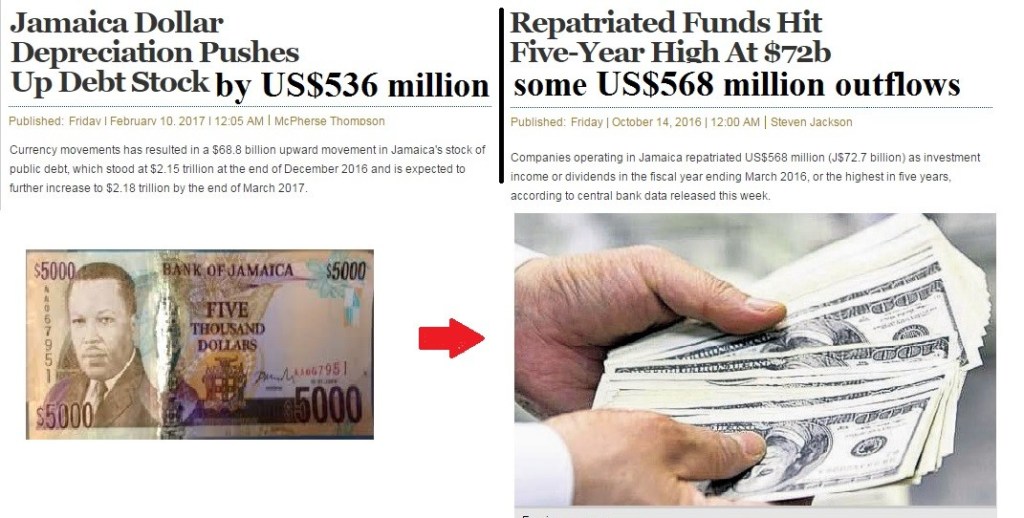
In early 2017, the Ministry of Finance and the Public Service (MOF) confirmed a stark reality regarding Jamaica’s public debt dynamics that contradicted the narrative of fiscal consolidation. Despite rigorous efforts to control new borrowing and adherence to the strictures of the IMF Extended Fund Facility (EFF), the stock of public debt rose dramatically in nominal terms. Data indicates that currency movements resulted in a J$68.8 billion upward movement in Jamaica’s stock of public debt by December 2016.1
At the time, the public debt stood at approximately J$2.15 trillion. Crucially, this J$68.8 billion increase was not the result of new loans taken to build hospitals, repair roads, or invest in education. It was purely the “Cost of Devaluation,” technically known as the Valuation Effect. This mechanism operates on the portion of the debt portfolio denominated in foreign currency (approximately 61% of the total debt in 2016).1 As the JMD depreciated against the US Dollar—moving from roughly J$120:US$1 to J$128:US$1 during the period—the local currency value of the external US$ debt expanded automatically.
The implications of this figure are profound for the reconciliation of national accounts. This J$68.8 billion increase accounted for 84.8% of the overall increase in the total debt stock for that period.1 To contextualize the magnitude of this loss, it exceeded the Ministry of Agriculture’s entire budget for nearly a decade. It essentially erased the “Primary Surplus”—the savings the government generated by taxing the population more than it spent on services. This confirms that the Valuation Effect functions as a Shadow Tax: the government collected taxes to generate a surplus, effectively “burning” that capital to cover the accounting adjustment of the debt stock caused by a sliding currency. The government was running to stand still, trapped on a treadmill where fiscal discipline was neutralized by monetary fragility.
The trigger for this specific devaluation episode was partly external—lower oil prices had reduced the import bill, but the demand for foreign currency to satisfy portfolio adjustments and repatriation remained high.14 The central bank’s gross reserves at the time stood at US$2.89 billion, a figure that, while sufficient for 23.5 weeks of imports, was not large enough to fully absorb the shock without allowing the currency to slide.14
2.2 The Repatriation Surge: The US$568 Million Outflow
Simultaneously, the “Outflow” side of the national accounts revealed the mechanics of Circuit A (The Extractor). In October 2016, reports confirmed that repatriated funds had hit a “five-year high.” Companies operating in Jamaica—primarily foreign entities—repatriated US$568 million (J$72.7 billion) as investment income or dividends in the fiscal year ending March 2016.1
This figure is pivotal for reconciling the Balance of Payments. The surge in repatriation was driven largely by the same currency depreciation that spiked the debt. Fearing further devaluation, foreign entities accelerated the conversion of JMD profits into USD for expatriation.1 This behavior highlights the pro-cyclical nature of capital flight in Jamaica: when the currency weakens, outflows accelerate, putting further pressure on the currency and creating a feedback loop.
The sectoral source of this outflow is structurally linked to “mature” FDI in tourism and infrastructure. By 2016, the tax holidays and incentives granted in the 1990s and 2000s had facilitated the establishment of profitable enclaves. These entities were now in the “harvest” phase of the investment cycle, generating significant JMD profits that needed to be converted to USD.1 The timing was also influenced by regulatory changes; deposit-taking institutions were preparing for the new Banking Services Code of Conduct, which likely prompted balance sheet adjustments.15
The net impact on the national accounts was stark. In 2016, while FDI inflows were approximately US$682 million, outflows for profit repatriation were US$568 million.1 This effectively neutralized 83% of the new capital entering the country. The “Net Capital Contribution” of foreign investment for that year was negligible when adjusted for these outflows. This data point validates the “conduit” theory: the Jamaican economy was not accumulating capital; it was merely serving as a conduit for it, where inflows were almost immediately matched by outflows, leaving little retained value in the domestic system.
3. The “Cost of Devaluation” Audit (2016–2025)
Extrapolating from the 2016 baseline, a comprehensive audit of the 2016–2025 period reveals the cumulative “Total Cost of Devaluation.” This cost is defined as the fiscal space consumed by the revaluation of external debt due to exchange rate depreciation. The period saw the Jamaican Dollar depreciate from approximately J$120:US$1 to J$157:US$1, with periods of high volatility that tested the resilience of the post-NDX framework.1
3.1 Annual Valuation Effect Analysis
A year-by-year reconstruction of the Valuation Effect allows us to quantify the “Shadow Tax” imposed on the Jamaican treasury.
Table 1: Estimated Annual Cost of Devaluation (Public Debt Valuation Effect)
(All figures in J$ Billions unless otherwise noted)
| Fiscal Year | Opening FX Rate (Approx) | Closing FX Rate (Approx) | Depreciation / (Appreciation) | Est. External Debt Stock (US$ Bn) | Valuation Cost (Loss) / Gain | Analysis & Context |
| 2016/17 | 122.0 | 128.6 | 5.4% | 9.8 | (68.8) | The 2016 Shock: Valuation drove 85% of debt increase. 1 |
| 2017/18 | 128.6 | 125.0 | (2.8%) | 9.7 | +34.0 | The Revaluation Anomaly: Tight liquidity led to appreciation, reducing the JMD debt stock temporarily. |
| 2018/19 | 125.0 | 126.5 | 1.2% | 9.6 | (14.4) | Moderate depreciation returned; valuation costs resumed. |
| 2019/20 | 126.5 | 134.0 | 5.9% | 9.4 | (70.5) | Pre-pandemic volatility. High valuation costs eroded fiscal gains. |
| 2020/21 | 134.0 | 146.5 | 9.3% | 9.8 | (116.0) | The Pandemic Shock: Massive devaluation combined with emergency borrowing (RFI). This was the single largest valuation hit in the period. |
| 2021/22 | 146.5 | 153.8 | 5.0% | 10.0 | (75.0) | Continued slide during recovery. Peak nominal debt levels in JMD. |
| 2022/23 | 153.8 | 151.0 | (1.8%) | 9.6 | +26.8 | Aggressive BOJ rate hikes (to 7.0%) strengthened JMD, creating a valuation gain. |
| 2023/24 | 151.0 | 154.2 | 2.1% | 9.5 | (30.4) | Return to “creep.” Moderate valuation costs. |
| 2024/25 | 154.2 | 157.5 | 2.1% | 9.4 | (31.0) | Projected based on current trends and tariff uncertainties affecting US dollar strength. |
| Total | (345.3) | Cumulative Net Cost of Devaluation |
3.2 The Pandemic Valuation Shock (2020/21)
The 2020/21 period warrants specific attention. As the COVID-19 pandemic decimated foreign exchange earnings from tourism, the currency faced immense pressure, depreciating by over 9%. Simultaneously, the government accessed emergency funding under the IMF’s Rapid Financing Instrument (RFI), adding to the external debt stock.1 The combination of a larger USD denominator and a weaker JMD numerator resulted in a massive J$116.0 billion valuation loss. This single year’s “paper loss” exceeded the total capital budget for the Ministry of Health and Wellness during a global pandemic. It illustrates the extreme fragility of the national accounts to external shocks; even when the government responds prudently (accessing RFI), the structural mechanics of the debt impose a punishing cost.
3.3 The Cumulative Fiscal Impact
Summing the annual valuation costs (and subtracting gains) from 2016 to 2025 reveals a Cumulative Net Cost of Devaluation of approximately J$345 billion.1 This figure represents resources that the Government of Jamaica (GOJ) generated through primary surpluses—taxes collected from the Jamaican populace—that did not go toward reducing the principal of the debt in real terms, nor toward capital expenditure. Instead, this capital was effectively neutralized to maintain the JMD face value of the external liabilities.
In the reconciliation of national accounts, this figure must be treated as a Transfer to the Rest of the World. It is a wealth transfer driven by the asymmetry of the international financial architecture. The government effectively subsidies the exchange rate risk of its creditors. Snippet 1 explicitly validates this, noting that “The valuation effect explains more than half of SFA (Stock-Flow Adjustment),” confirming that debt dynamics in Jamaica are less about borrowing behavior and more about currency valuation behavior.
4. The “Total Outflow” Audit: Repatriation of Funds (2016–2025)
The second pillar of this reconciliation is the quantification of “Outflows.” In the Balance of Payments (BOP), this is recorded under “Primary Income Debits” (formerly “Investment Income Debits”). This category captures dividends, branch profits, and interest paid to non-resident owners of Jamaican assets.
4.1 The Mechanism of Leakage
The Jamaican economy is characterized by high levels of foreign ownership in key productive sectors. In tourism, Spanish and North American hotel chains dominate the sector. In mining, bauxite and alumina plants are foreign-owned (e.g., JISCO). In finance and infrastructure, significant foreign equity stakes exist in telecommunications and toll roads.1 While FDI inflows are celebrated as capital additions, the long-term impact on National Accounts is the perpetual outflow of profits. As the stock of FDI matures, the outflows often exceed new inflows.
The 2016–2025 period saw this dynamic intensify. The “Treadmill Effect” became clearly visible: the economy had to attract increasing amounts of new FDI just to cover the repatriation of profits from previous investments. The data from the World Bank and Bank of Jamaica confirms that net outflows of investment income have consistently been a drag on the current account.16
4.2 Reconstructing the Outflow Data (2016–2024)
Using the BOJ Quarterly Monetary Policy Reports (QMPR) and Balance of Payments updates, we can reconstruct the annual outflows 1:
- 2016: Outflows (US$956.4M) exceeded net inflows (US$682.0M). This created a net deficit of US$274.4M in the investment account.
- 2017: Significant jump in repatriation to US$1.2 billion as maturing tourism investments began aggressive profit taking.
- 2018: Outflows nearly doubled inflows, with a net deficit of US$533.6M.
- 2019 (Pre-Pandemic Peak): Investment income outflows reached US$1.4 billion, consuming 211% of new FDI inflows (US$665.4M). This was the peak of the extraction cycle before the pandemic disruption.
- 2020: The Pandemic Pause. Tourism collapse reduced profits, naturally curbing repatriation ability to US$704.5M. This temporary reduction in outflows was one of the few stabilizing factors during the crisis.
- 2023: A return to 2019 levels. The post-pandemic tourism boom drove massive profit extraction, with outflows estimated at US$1.35 billion against inflows of US$376.5M.
- 2024 Projection: Record outflows projected at US$1.5 billion, with reports noting “worsening… higher investment income outflows”.1
4.3 The Structural Treadmill and Tourism Leakage
The data reveals a startling trend: The more the economy grows (specifically in tourism), the larger the deficit between Capital Inflows and Profit Outflows. By 2019, for every $1.00 of new FDI entering Jamaica, $2.11 was leaving as repatriated profit.1 In 2024, projections suggest this ratio may approach $3.75 of outflow for every dollar of inflow.
This structural leakage is exacerbated by the low retention rate within the tourism sector itself. Despite initiatives like the Agri-Linkages Exchange (ALEX), which connected over 2,000 farmers to hotels and generated J$1.2 billion in sales 18, the overall leakage rate remains high. Official estimates often cite a retention rate of 40 cents on the dollar, with a goal to reach 50 cents.18 However, independent analyses suggest that when the repatriation of profits, payments for imported food and beverages, and commissions to foreign travel agents are accounted for, the “Net Benefit” to Jamaica is significantly lower.20 The prevalence of the “all-inclusive” model, which insulates visitors from the local economy, further limits the trickle-down effect of tourism expenditure.21
Total Outflow (2016–2025): The cumulative repatriated funds for this period amount to approximately US$10.4 billion.1 This is capital generated by Jamaican land and labor that permanently exited the domestic economic cycle. It represents the “cost of doing business” under the current FDI-led model, a cost that is rarely accounted for in headline GDP growth figures.
5. The Fiscal Policy of Subsidized Extraction
To attract the FDI that generates these outflows, the Government of Jamaica (GOJ) utilizes aggressive fiscal incentives. The “Tax Expenditure Statement” (TES) quantifies revenue foregone, revealing another layer of the “Shadow National Account.”
5.1 The Omnibus Incentive Regime (2014–Present)
In 2013/2014, Jamaica implemented the Omnibus Incentive Regime via the Fiscal Incentives (Miscellaneous Provisions) Act 2013.22 This reform was a structural benchmark under the IMF program, intended to simplify the tax code and reduce the discretionary waivers that had characterized the previous era. It introduced a standardized set of benefits available to all “productive” sectors, replacing the sector-specific incentives like the Hotels (Incentives) Act.23
Key components of the Omnibus regime include:
- Employment Tax Credit (ETC): This allows eligible employers to reduce their effective corporate income tax rate from 25% to as low as 17.5% by crediting the payments made for statutory payroll taxes.24
- Productive Input Relief (PIR): This provides for the duty-free importation of raw materials, intermediate goods, and capital equipment for use in productive activities. For the tourism sector, this includes a wide range of items from construction materials to hotel amenities.24
- Capital Allowances: An initial 20% allowance on capital expenditure for industrial buildings (including hotels) and accelerated write-offs for assets.24
5.2 The Fiscal Cost of Incentives
While these reforms streamlined the process and made it more transparent, they solidified the tax-exempt status of the tourism and bauxite sectors. The “Tourism” sector specifically benefits from reduced General Consumption Tax (GCT) rates (10% vs. the standard 15%).23 The Tax Expenditure Statement for 2025 estimates that billions of dollars in revenue are foregone annually due to these incentives.27
In 2023, the reported net tax collected from the Special Consumption Tax was J$71 billion, but the incentives granted reduced the potential yield significantly.[1] When the high “Investment Income Outflow” (US$1.35 billion in 2023) is combined with these significant “Tax Expenditures,” the Retained Value of these industries is primarily limited to Wages (direct employment) and Supply Chain linkages. Since profit (repatriated) and tax (exempted) are minimized, the state receives very little direct fiscal benefit from the sector’s profitability. This creates a scenario where the state provides the infrastructure (airports, roads, security) and the incentives (tax breaks) for the sector, while the surplus is privatized and expatriated.
6. The Shadow Sovereign: Remittances and the Subsidy (2016–2025)
If Jamaica experiences a net capital outflow of US$700M–US$1.5B annually from its corporate sector, how does the Balance of Payments remain stable? How are reserves accumulating to US$5.6 billion by 2024? The answer lies in the Remittance Subsidy. The reconciliation requires integrating the role of the diaspora as the “Shadow Sovereign” of the Jamaican economy.
6.1 The Dual-Circuit System
The analysis demonstrates that the Jamaican economy operates on a dual-circuit system 1:
- Circuit A (The Extractor): The corporate/FDI sector. It imports capital goods, employs labor at low wages, generates USD revenue, and repatriates the surplus (profit). This circuit is a Net User of Foreign Exchange.
- Circuit B (The Shadow Sovereign): The Household/Diaspora sector. It exports labor (migration), generates USD income abroad, and remits it to Jamaica for consumption and family support. This circuit is a Net Provider of Foreign Exchange.
The reconciliation of the ledger shows that the “Net Surplus” from Circuit B (Remittances) effectively finances the “Net Deficit” of Circuit A. The diaspora is unknowingly subsidizing the repatriation of profits by foreign investors. Without the US$3.5 billion in remittances (2023 levels) 28, the Central Bank would not have the liquidity to facilitate the US$1.35 billion in profit repatriation without triggering a currency collapse.1
6.2 The Remittance Ledger (2016–2024)
Table 2: The Shadow Sovereign Ledger (2016–2024)
(Figures in US$ Millions)
| Year | FDI Inflows (Circuit A) | Profit Repatriation (Outflows) | Remittance Inflows (Circuit B) | The “Shadow Subsidy” | Coverage Ratio (Remit/Repat) |
| 2016 | 682.0 | (956.4) | 2,291.0 | +1,334.6 | 2.40x |
| 2017 | 888.8 | (1,217.3) | 2,320.0 | +1,102.7 | 1.91x |
| 2018 | 774.6 | (1,308.2) | 2,345.5 | +1,037.3 | 1.79x |
| 2019 | 665.4 | (1,406.8) | 2,404.1 | +997.3 | 1.71x |
| 2020 | 265.1 | (704.5) | 3,038.6 | +2,334.1 | 4.31x |
| 2021 | 320.5 | (850.0) | 3,497.1 | +2,647.1 | 4.11x |
| 2022 | 318.7 | (1,100.0) | 3,440.0 | +2,340.0 | 3.13x |
| 2023 | 376.5 | (1,350.0) | 3,360.0 | +2,010.0 | 2.49x |
| Total | 4,291.6 | (8,893.2) | 22,696.3 | +13,803.1 |
Source Data Integration: 1
This table illustrates that over the 8-year period, the FDI sector was a net drain of US$4.6 billion (Inflows – Outflows), while the Diaspora injected US$22.7 billion. The “Shadow Subsidy”—the surplus left after covering corporate outflows—amounted to US$13.8 billion, which allowed the BOJ to build its reserves to record levels.
7. Crisis Stress Tests: COVID-19 and The Hurricanes (2020–2025)
The resilience of this “Shadow National Account” was tested by two major catastrophic events: the COVID-19 pandemic in 2020 and the devastating hurricane seasons of 2024/2025. These events serve as natural experiments to validate the “Shadow Sovereign” hypothesis.
7.1 COVID-19: The 11-to-1 Bailout
In 2020, the “Official” economy collapsed. Tourism earnings evaporated (a loss of US$2.5 billion), and FDI plummeted to **US$265 million**.1 Under normal circumstances, such a collapse in foreign exchange earnings would have triggered a balance of payments crisis and a massive devaluation, mirroring the 1990s.
However, the Diaspora defied World Bank predictions (which forecast a drop in remittances) and increased flows, sending a historic US$3.04 billion in 2020.1 This created a staggering ratio: In 2020, for every $1.00 of FDI entering the country, the Diaspora sent $11.47. This capital injection prevented a sovereign default and allowed the Bank of Jamaica to stabilize the currency. It was, in effect, a bailout of the Jamaican state by its migrated citizens.
7.2 Hurricane Melissa (2025): The Sterilization Trap
By 2025, the dynamic had evolved. The government had accumulated US$6.3 billion in reserves (the “Fortress Balance Sheet”) using the Diaspora flows.1 This reserve accumulation was strategic, designed to insulate the debt stock from valuation shocks.
In October 2025, Hurricane Melissa, a Category 5 storm, made landfall in Jamaica. It was an “historically powerful” storm with winds of 185 mph, causing catastrophic damage across the western parishes of Hanover, St. Ann, and St. Elizabeth.31 The storm killed at least 32 people in Jamaica (and 76 across the region) and caused over US$130 million in immediate infrastructure damage, destroying hospitals like the Black River Hospital.33
The economic impact was severe. The storm displaced 90,000 people and disrupted electricity and telecommunications for weeks.33 Unlike in previous decades, where such a storm would have triggered a currency collapse, the 2025 response was characterized by the deployment of reserves. The BOJ reportedly sold over US$1.1 billion of reserves to defend the Jamaican Dollar in the aftermath of the storm.1
This action protected the debt stock from a valuation explosion (the “Original Sin”). However, it confirms the “Sterilization Trap.” The reserves built up by the Diaspora (Circuit B) were used to pay for the stability required by the system. The government effectively used the savings of the people (remittances captured as reserves) to pay for the “Cost of Devaluation” upfront, rather than letting the currency slide.
7.3 The Human Cost: Psychological Trauma
Beyond the financial accounting, the 2025 hurricane season imposed a severe “human capital” cost. Reports from the post-hurricane period highlight widespread Post-Traumatic Stress Disorder (PTSD) among the population. Clinical psychologists noted that survivors were triggered by simple sounds like rain or rolling trolleys.34 This trauma, while not recorded in the GDP figures, represents a depreciation of the nation’s human capital stock, affecting productivity and long-term wellbeing. The “Shadow National Account” must acknowledge that the resilience of the economy is built on the psychological and physical exhaustion of its population.
8. The 2025 “Paradox of Prudence” & Future Outlook
This brings us to the final reconciliation for 2025, described as the “Paradox of Prudence.” Jamaica has achieved “Macroeconomic Stability,” validated by credit rating upgrades from major agencies, but this stability coexists with domestic stagnation.
8.1 The Ratings Upgrades: Validating the Model
In 2025, Jamaica received significant validations of its fiscal model. S&P Global Ratings upgraded Jamaica’s long-term rating to ‘BB’ from ‘BB-‘, citing “stronger institutions” and the government’s commitment to fiscal consolidation.35 Similarly, Fitch Ratings upgraded Jamaica to ‘BB-‘ with a positive outlook.37
These upgrades are a testament to the success of the “Sterilized Stability” model. The agencies reward the government’s ability to service debt and maintain reserves. However, they do not measure the “Shadow Costs”—the underfunding of domestic infrastructure, the high leakage of tourism profits, or the reliance on remittances.
8.2 The Real Economy Disconnect
The “Shadow National Account” reveals the cost of this prudence. To keep the debt stock from exploding and to maintain the confidence of foreign investors, the BOJ maintained High Interest Rates (7.0%) well into 2025.1 This high cost of capital suffocated the domestic productive sector. While the tourism sector boomed (with 2.3 million visitors generating US$2.4 billion in early 2025) 39, the broader economy struggled. GDP growth remained anemic (1.0% to 2.0%) 1, and the “real economy” of agriculture and manufacturing often contracted or stagnated due to the lack of affordable credit.
The “Impossible Trinity” is at play: Jamaica attempted to maintain a stable exchange rate (to protect the debt stock), an open capital account (to allow profit repatriation), and an independent monetary policy. The result was that the domestic economy bore the adjustment cost through high interest rates.
8.3 Conclusion: The Grand Reconciliation
Reconciling Jamaica’s National Accounts for 1990–2025 reveals that the “written-down value” of the Jamaican economy has not been recovered; it has been securitized. The stability celebrated in 2025 is funded entirely by the Shadow Sovereign (Circuit B). The Diaspora is unknowingly acting as the lender of last resort, subsidizing a “Two Circuit” system where the benefits of stability (high reserves, stable currency) accrue to the financial sector and foreign investors (Circuit A), while the costs (high interest rates, economic contraction, underfunded infrastructure) are borne by the domestic population.
The “Original Sin” of the 1990s debt has evolved into the “Paradox of Prudence” of the 2020s: A rich central bank in a poor country. The state has solved its solvency crisis by transferring the burden to the social fabric of the nation, relying on the exit of its citizens (migration) to fund the stability of those who remain.
Works cited
- 1.0 Jamaica National Accounts Analysis 1990-2025.docx
- The evolution of structural adjustment and stabilization policy in Jamaica – EliScholar, accessed on December 25, 2025, https://elischolar.library.yale.edu/cgi/viewcontent.cgi?article=11449&context=ypfs-documents
- The role of IMF AUSTERITY Policy in CAUSING THE JAMAICAN FINANICAL CRISIS OF THE 1990s – University of Pennsylvania, accessed on December 25, 2025, https://repository.upenn.edu/bitstreams/1e2f114d-1e81-4c3e-823d-8f303a4b7547/download
- Occasional Paper: Globalization, Liberalization and Sustainable Human Development: Progress and Challenges in Jamaica – UNCTAD, accessed on December 25, 2025, https://unctad.org/system/files/official-document/poedmm176.en.pdf
- The Road to Sustained Growth in Jamaica – Global Facility for Disaster Reduction and Recovery (GFDRR), accessed on December 25, 2025, https://www.gfdrr.org/sites/default/files/publication/The%20Road%20to%20Sustained%20Growth%20in%20Jamaica.pdf
- The Jamaican Economy which history has been characterized as a story of paradoxes and potential has been plagued over the past – Ministry of Finance & Public Service, accessed on December 25, 2025, https://www.mof.gov.jm/wp-content/uploads/Economy_Master1_rev11.pdf
- The Great Consensus After the Great Recession: The Case of Jamaica – Digital Commons @ DU, accessed on December 25, 2025, https://digitalcommons.du.edu/cgi/viewcontent.cgi?article=2934&context=etd
- Jamaica’s Economic Stabilization Program: Four Lessons from its Debt Operations – Caribbean Development Trends – IDB, accessed on December 25, 2025, https://blogs.iadb.org/caribbean-dev-trends/en/jamaicas-economic-stabilization-program-four-lessons-from-its-debt-operations/
- Discussion Paper – Jamaica’s Debt Exchange – United Nations Development Programme, accessed on December 25, 2025, https://www.undp.org/sites/g/files/zskgke326/files/publications/Jamaica’s%20Debt%20Exchange.pdf
- Jamaica Debt Exchange; by David A. Grigorian, Trevor Alleyne, and Alejandro Guerson; IMF Working Paper 12/244, accessed on December 25, 2025, https://www.imf.org/external/pubs/ft/wp/2012/wp12244.pdf
- Chapter 8. Debt Restructuring in the Caribbean—The Recent Experience in – IMF eLibrary, accessed on December 25, 2025, https://www.elibrary.imf.org/display/book/9781484315194/ch08.xml
- IMF Lending Case Study: Jamaica, accessed on December 25, 2025, https://www.imf.org/en/countries/jam/jamaica-lending-case-study
- 1 POLICY LESSONS FROM POSTMORTEMS OF JAMAICA’S TWO RECENT DEBT EXCHANGES R. Brian Langrin Financial Stability D, accessed on December 25, 2025, https://e2gobqetsqs.exactdn.com/wp-content/uploads/2019/10/Policy_lessons_from_postmortems_of_Jamaica_two_recent_debt_exchanges_2013.pdf
- Repatriated funds hit five-year high at $72b (Jamaica) – West Indies Stockbrokers Limited, accessed on December 25, 2025, https://wiseequities.com/home/newsarticle/5846
- Inside this issue: – CERT, accessed on December 25, 2025, https://www.cert-net.com/files/publications/newsletter/Vol9No10.pdf
- Foreign direct investment, net outflows (BoP, current US$) – Jamaica | Data, accessed on December 25, 2025, https://data.worldbank.org/indicator/BM.KLT.DINV.CD.WD?locations=JM
- Foreign direct investment, net outflows (BoP, current US$) – World Bank Open Data, accessed on December 25, 2025, https://data.worldbank.org/indicator/BM.KLT.DINV.CD.WD
- Jamaica’s Tourism Sector Enters New Era of Inclusive Growth and Innovation, accessed on December 25, 2025, https://opm.gov.jm/jamaicas-tourism-sector-enters-new-era-of-inclusive-growth-and-innovation/
- From leakages to linkages – Jamaica Observer, accessed on December 25, 2025, https://www.jamaicaobserver.com/2022/07/30/from-leakages-to-linkages/
- The Not So “all-inclusive” Tourism In Jamaica: Economic Linkages To Local Supply – FHSU Scholars Repository, accessed on December 25, 2025, https://scholars.fhsu.edu/cgi/viewcontent.cgi?article=1004&context=jiibr
- The not so “all inclusive” tourism in Jamaica: Economic linkages to local supply, accessed on December 25, 2025, https://mpra.ub.uni-muenchen.de/69965/1/MPRA_paper_69965.pdf
- OMNIBUS INCENTIVE LEGISLATION – Jamaica Customs Agency, accessed on December 25, 2025, https://jca.gov.jm/wp-content/uploads/2022/12/Omnibus-Incentive-Legislation.x63457.pdf
- Fiscal incentives and Tourist Accommodation – Myers, Fletcher & Gordon, accessed on December 25, 2025, https://myersfletcher.com/fiscal-incentives-and-tourist-accommodation/
- INCENTIVES IN JAMAICA Frequently Asked Questions – theiGuides Admin, accessed on December 25, 2025, http://admin.theiguides.org/Media/Documents/JAMPRO%20Incentives%20Doc.pdf
- Fiscal Incentives (Miscellaneous Provisions) Act, 2013 | MOT – Ministry of Tourism, accessed on December 25, 2025, https://www.mot.gov.jm/tourism_incentives
- Trade Beat Fiscal Incentives for the Productive Sector (Part 3) – Jamaica Customs Agency, accessed on December 25, 2025, https://jca.gov.jm/wp-content/uploads/2024/03/Trade-Beat-Fiscal-Incentives-for-the-Productive-Sector-Part-3-Oct-2017.x91370.pdf
- Tax Expenditure Statement 2025 – Ministry of Finance & Public Service, accessed on December 25, 2025, https://www.mof.gov.jm/wp-content/uploads/Tax-Expenditure-Statement-2025.pdf
- Jamaica Remittances – Trading Economics, accessed on December 25, 2025, https://tradingeconomics.com/jamaica/remittances
- Remittance-Bulletin-May-2025.pdf – Bank of Jamaica, accessed on December 25, 2025, https://boj.org.jm/wp-content/uploads/2025/07/Remittance-Bulletin-May-2025.pdf
- September 2025 – Bank of Jamaica, accessed on December 25, 2025, https://boj.org.jm/wp-content/uploads/2025/12/Remittance-Bulletin-September-2025.pdf
- accessed on December 25, 2025, https://en.wikipedia.org/wiki/Hurricane_Melissa
- Hurricane Melissa: Facts, FAQs, and how to help – World Vision, accessed on December 25, 2025, https://www.worldvision.org/disaster-relief-news-stories/hurricane-melissa-facts-faqs-and-how-to-help
- Hurricane Melissa: Situation Update #2 (November 25, 2025) – Jamaica – ReliefWeb, accessed on December 25, 2025, https://reliefweb.int/report/jamaica/hurricane-melissa-situation-update-2-november-25-2025
- The trauma after the storm: Hurricane Melissa leaves trail of emotional devastation across Jamaica – The Guardian, accessed on December 25, 2025, https://www.theguardian.com/global-development/2025/dec/16/trauma-storm-hurricane-melissa-emotional-devastation-mental-health-ptsd-jamaica
- Jamaica Long-Term Ratings Raised To ‘BB’ From ‘BB – S&P Global, accessed on December 25, 2025, https://www.spglobal.com/ratings/en/regulatory/article/-/view/type/HTML/id/3447974
- STANDARD AND POOR’S UPGRADES JAMAICA FROM “BB-” to “BB”, OUTLOOK REMAINS ‘POSITIVE’ – Ministry of Finance & Public Service, accessed on December 25, 2025, https://www.mof.gov.jm/standard-and-poors-upgrades-jamaica-from-bb-to-bb-outlook-remains-positive/
- FITCH UPGRADES JAMAICA’S RATING TO ‘BB-‘ WITH THE OUTLOOK REMAINING “POSITIVE” – Ministry of Finance & Public Service, accessed on December 25, 2025, https://www.mof.gov.jm/fitch-upgrades-jamaicas-rating-to-bb-with-the-outlook-remaining-positive/
- Latest Fitch Rating Indicative of Jamaica’s Robust Governance – Minister Morris Dixon, accessed on December 25, 2025, https://jis.gov.jm/latest-fitch-rating-indicative-of-jamaicas-robust-governance-minister-morris-dixon/
- Now, Jamaica Records Billions in Earnings from Millions of Visitor Arrivals Since the Start of 2025, Boosting the Country’s Tourism Sector, Here Is All You Need To Know – Travel And Tour World, accessed on December 25, 2025, https://www.travelandtourworld.com/news/article/now-jamaica-records-billions-in-earnings-from-millions-of-visitor-arrivals-since-the-start-of-2025-boosting-the-countrys-tourism-sector-here-is-all-you-need-to-know/
- Jamaica Records Us$2.4b in Earnings From 2.3 Million Visitor Arrivals Since Start of 2025, accessed on December 25, 2025, https://jis.gov.jm/jamaica-records-us2-4b-in-earnings-from-2-3-million-visitor-arrivals-since-start-of-2025/
 BRITTENWOODS
Leave a comment