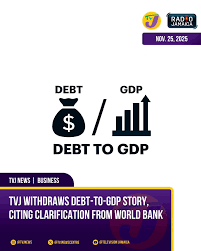
Based on the detailed narrative analysis and the “Shadow National Account” framework, the dramatic reduction of Jamaica’s debt-to-GDP ratio—from a peak of roughly 151% to approximately 68% by 2025—is not viewed as a contradiction of the extraction model, but rather as the primary product of the “Shadow Sovereign” system.
In the context of the report, this 68% figure represents a metric of State Solvency rather than National Prosperity. Here is how the debt reduction is reconciled within the analysis:
The analysis argues that the government achieved this debt reduction by running massive primary fiscal surpluses—taxing the domestic economy more than it spent on services for over a decade. In a normal economy, sucking this much liquidity out via taxes would cause a recession and social unrest.
However, the Shadow National Account reveals that Circuit B (The Diaspora) filled the gap. As the government taxed local income to pay down foreign debt (reducing the numerator), the Diaspora sent record remittances (US$3.5 billion/year) to households to maintain consumption levels.
The debt didn’t just “disappear” through growth; it was paid down by indirectly transferring the wealth of the Diaspora into the Treasury via consumption taxes on remitted funds. The 68% ratio is essentially a receipt of the Diaspora’s subsidy to the state.
The Debt-to-GDP ratio has two parts: the Debt (Numerator) and the GDP (Denominator). The reduction was aided significantly by the growth of the Denominator (GDP), driven largely by the recovery and expansion of tourism (Circuit A).
While GDP grew, the analysis shows that a significant portion of that growth was “hollow” because of profit repatriation. Foreign Direct Investment (FDI) in tourism swelled the GDP figures, making the debt look smaller by comparison. However, since up to 60 cents of every tourism dollar leaks out the taxable base for the government grew slower than the headline GDP suggests. This forced the government to maintain high tax rates on the domestic population to capture enough revenue to service the debt.
The report characterizes the 68% ratio as a pyrrhic victory described as the “Paradox of Prudence”. To get the debt to 68%, the state had to maintain “Macroeconomic Stability” to satisfy rating agencies like S&P and Fitch, who upgraded Jamaica to ‘BB’ levels in 2025.
To maintain this stability and protect the debt stock from the “Valuation Effect” (currency depreciation), the Bank of Jamaica kept interest rates high (7.0%) and accumulated “sterile” reserves ($6.3 billion).
The “Shadow Cost” of achieving 68% debt-to-GDP was the starvation of the domestic productive sector (agriculture, local manufacturing), which could not afford the high interest rates. Thus, the debt ratio improved, but the indigenous economy stagnated.
The analysis acknowledges that the reduction was structurally enabled by the Jamaica Debt Exchange (JDX) and National Debt Exchange (NDX) of 2010 and 2013. These events forcefully lowered the interest burden, allowing the government to divert funds from interest payments to principal reduction.
The “Shadow National Account” views this as the moment the burden was shifted from external creditors to domestic savers (pension funds and insurance companies), who took the “haircut.” This “financial repression” was the first step in the long march to 68%, effectively securitizing the domestic financial sector to save the sovereign balance sheet.
In summary, the reduction to 68% debt-to-GDP confirms the efficiency of the “Sterilized Stability” model: the state successfully saved itself by utilizing the Diaspora (Remittances) to subsidize the extraction of foreign capital (Repatriation), while imposing strict austerity on the domestic population to balance the books.
 BRITTENWOODS
Leave a comment