A Strategic Cost-Benefit Analysis of Jamaican Accession to the BRICS Economic Bloc in the Era of Geoeconomic Fragmentation
Executive Summary
February 2026 marks a watershed moment in the economic history of the Caribbean. Against a backdrop of fracturing global hegemony and the accelerating regionalization of trade, Jamaica finds itself in a paradoxical position of vulnerability and unprecedented strength. The nation’s Net International Reserves (NIR) have surged to a historic high of US$6.73 billion as of January 2026, providing an import cover of 36.1 weeks—triple the international benchmark of 12 weeks. This accumulation of sovereign liquidity, driven by catastrophe insurance payouts following Hurricane Melissa and disciplined fiscal management, has endowed the Bank of Jamaica (BOJ) with a strategic “war chest” capable of capitalizing on shifting global financial architectures.
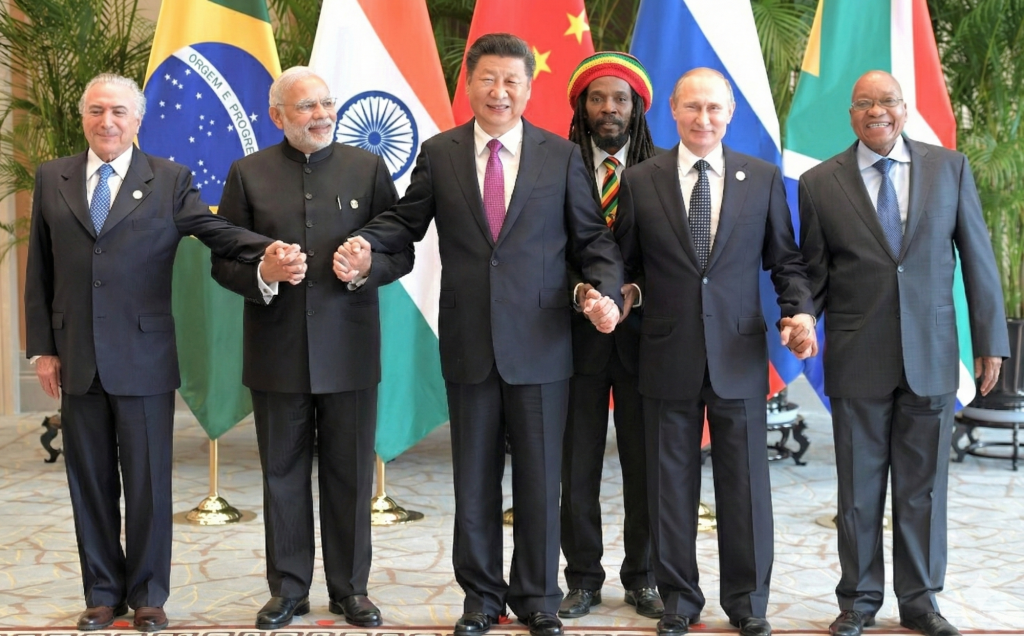
Simultaneously, the geopolitical landscape has undergone a seismic realignment. The BRICS bloc—originally Brazil, Russia, India, China, and South Africa—has successfully expanded into a “BRICS+” formation, integrating Egypt, Ethiopia, Iran, the United Arab Emirates (UAE), and Indonesia. This expanded coalition now commands approximately 39% of global GDP and has operationalized alternative financial infrastructures, most notably the New Development Bank (NDB) and the “mBridge” digital currency platform, which processed US$55 billion in transactions by late 2025.
This report provides an exhaustive cost-benefit analysis of Jamaica utilizing its robust reserve position to seek membership or “Partner Country” status within the BRICS bloc. The core thesis of this assessment is that Jamaica’s excess liquidity allows it to engage in “sovereign arbitrage”—leveraging idle USD reserves to buy into low-cost, non-conditional development financing and efficient payment rails offered by the Global South, while mitigating the rising costs of Western financial alignment.
Summary of Key Findings
- Capital Efficiency: Jamaica’s US6.73 billion reserve position renders the cost of NDB membership negligible. Based on the accession models of comparable economies like Uruguay and Bangladesh, Jamaica would likely face a subscribed capital requirement of US500 million to US1 billion, with only 20% (US100–200 million) required as paid-in capital over several years. This expenditure represents less than 3% of current reserves, yet it unlocks borrowing multiples of up to 2.5x in local currency-denominated loans.
- Transaction Cost Reduction: The Caribbean is currently suffering from a severe “de-risking” crisis, with correspondent banking fees and FX spreads consuming 3–5% of cross-border trade value. Adoption of the mBridge and BRICS Pay platforms for trade with China, Brazil, and India could reduce these settlement costs by approximately 90%, generating aggregate savings of US$150–200 million annually for the Jamaican economy.
- Debt Restructuring: 88.8% of Jamaica’s external debt is denominated in US Dollars, exposing the fiscal account to Federal Reserve interest rate shocks. Accession to the NDB offers a pathway to “de-dollarize” future sovereign debt through local currency financing (JMD or synthetic baskets), hedging against the volatility of the US Treasury yield curve.
- Geopolitical Risk Calculus: The primary cost of alignment is the potential revocation of trade preferences under the Caribbean Basin Initiative (CBI) and diplomatic estrangement from the United States. However, the analysis suggests this cost is already partially realized; the US Department of State’s January 2026 pause on immigrant visas for 75 countries, including Jamaica, indicates a deterioration in bilateral relations independent of BRICS alignment. This lowers the marginal geopolitical cost of pivoting, increasing the attractiveness of a diversification strategy.
The report concludes that while full political membership carries significant risks to the tourism sector and CBI status, a “Partner Country” approach focused on financial integration (NDB membership and mBridge participation) maximizes economic utility while maintaining a veneer of diplomatic neutrality.
1. Macroeconomic Baseline: The Strategic Utility of Excess Reserves
To understand the feasibility of Jamaica joining the BRICS bloc, one must first deconstruct the country’s current financial standing. In early 2026, Jamaica is not approaching the Global South as a distressed borrower seeking a bailout, but as a solvent sovereign seeking yield and efficiency. This distinction is critical; it shifts the negotiating dynamic from dependency to partnership.
1.1 The Anatomy of the 2026 Reserve Surge
As of January 31, 2026, the Bank of Jamaica reported Net International Reserves (NIR) of US$6.73 billion, a 22.4% increase year-on-year. This accumulation is anomalous for a Small Island Developing State (SIDS) recovering from a major hurricane (Hurricane Melissa, October 2025) and requires dissection to understand its durability.
The reserve growth was driven by three primary vectors:
- Reinsurance and Catastrophe Inflows: The triggering of the Caribbean Catastrophe Risk Insurance Facility (CCRIF) and catastrophic bond payouts injected immediate hard currency liquidity (approx. US$242 million) into the central bank following Hurricane Melissa.
- Multilateral Support: The International Monetary Fund (IMF) approved a US$415 million disbursement under the Rapid Financing Instrument (RFI) in January 2026. Unlike traditional structural adjustment loans, this liquidity was front-loaded to support balance of payments stability.
- Fiscal Compression: The Government of Jamaica (GOJ) maintained a high primary surplus, dampening import demand and allowing the central bank to accumulate foreign assets rather than defending a sliding currency.
Table 1.1: Jamaica Net International Reserves Profile (January 2026)
Component
Value (US$ Millions)
Change vs. Jan 2025
Strategic Implication
Total Foreign Assets
$6,744.64
+21.5%
High liquidity buffer for strategic investments.
Foreign Liabilities
($13.04)
-73.5%
Minimal short-term encumbrances to the IMF.
Net International Reserves
$6,731.59
+22.4%
Historic high; exceeds statutory requirements.
Import Cover
36.1 Weeks
+7.2 Weeks
Far exceeds the 12-week prudential benchmark.
Source: Data derived from Bank of Jamaica and NCB Capital Markets reports.
1.2 The Opportunity Cost of “Lazy Capital”
While high reserves project stability, they also represent a significant opportunity cost. The majority of these reserves are likely held in US Treasury securities or highly liquid deposits with Western central banks. In the 2026 interest rate environment, with the US Federal Reserve potentially cutting rates or stabilizing them around 4.29% , the real return on these assets is modest when adjusted for US inflation and the depreciation risk of the JMD.
Net Savings Calculation: The adoption of mBridge/BRICS Pay for Chinese trade alone yields US$47.1 million in annual savings. When expanded to include India (pharmaceuticals, vehicles) and Brazil (foodstuffs), the aggregate savings for the Jamaican economy could exceed US$100 million annually.
Holding 36 weeks of import cover is conservative to the point of inefficiency. Standard economic theory suggests that reserves above the 12-15 week threshold yield diminishing returns in terms of credit rating support. This implies that Jamaica possesses approximately US$3–4 billion in “excess” reserves—capital that is currently earning low yields in Western accounts but could be deployed to capitalize new multilateral relationships without threatening domestic financial stability.
The central economic question, therefore, is whether reallocating a fraction of this excess liquidity (e.g., 5-10%) into BRICS institutional capital (NDB shares) or BRICS-denominated assets (The Unit, Gold, Yuan bonds) yields a higher risk-adjusted return than the status quo.
2. Institutional Mechanics: The Cost and Benefit of BRICS Financial Architecture
The BRICS economic proposition is anchored in two institutions: the New Development Bank (NDB) and the Contingent Reserve Arrangement (CRA). Unlike the political grouping, which requires consensus on geopolitical issues, these institutions function as corporate entities where influence is purchased through capital subscription.
2.1 The New Development Bank (NDB): Development without Devaluation
The NDB, established in 2015, was designed to address the infrastructure financing gap in emerging markets. By 2026, it has admitted new members including Bangladesh, Egypt, the UAE, and Uruguay. For Jamaica, NDB membership offers a specific arbitrage opportunity against the World Bank (IBRD).
2.1.1 The Cost of Entry: Capital Subscription Analysis
Membership in the NDB does not require a country to be a full political member of BRICS; it is open to all UN members. The cost of entry is determined by the subscribed capital, of which only 20% is “paid-in” (cash), while 80% is “callable” (a guarantee utilized only in the event of bank distress).
Using the accession of comparable economies as a benchmark:
- Bangladesh: Subscribed to 9,420 shares ($942 million). Paid-in capital is approximately $188 million.
- Egypt: Subscribed to 11,960 shares ($1.196 billion). Paid-in capital is approximately $239 million.
- Uruguay: While specific share counts are pending finalization in the data, it is categorized similarly to smaller emerging markets.
Projected Cost for Jamaica: Given Jamaica’s GDP and economic profile relative to Uruguay and Bangladesh, a feasible subscription would likely range between US500 million and US800 million.
- Paid-in Requirement (20%): US100 million – US160 million.
- Payment Schedule: Typically spread over 7 installments.
- Annual Liquidity Impact: ~$15–23 million per year for 7 years.
Conclusion on Cost: For a central bank holding US6.73 billion in reserves, an upfront commitment of ~US23 million annually is statistically insignificant (0.3% of reserves). It poses no threat to the BOJ’s ability to defend the currency or service existing debt.
2.1.2 The Benefit: Local Currency Lending and Non-Conditionality
The primary value proposition of the NDB is not merely access to capital—Jamaica already has access to the IBRD and IDB—but the terms of that capital.
- De-Risking “Original Sin”: The NDB has an explicit mandate to increase local currency financing to 30% of its portfolio by 2026. Current Multilateral Development Banks (MDBs) like the World Bank lend primarily in USD. When the Jamaican Dollar devalues, the real cost of these loans skyrockets.
- The NDB Mechanism: The NDB can issue JMD-denominated bonds (or use cross-currency swaps) to lend to Jamaica in JMD. This transfers the FX risk from the Jamaican Treasury to the NDB’s balance sheet (which manages it via diversification).
- Quantifiable Benefit: If Jamaica borrows US500 million for infrastructure. A 10% depreciation of JMD adds US50 million to the debt stock in local terms under IBRD terms. Under NDB local currency terms, the debt stock remains stable relative to tax revenues.
- Speed and Conditionality: The NDB targets a 6-month loan approval cycle. More importantly, it operates without the policy conditionality (e.g., austerity measures, privatization mandates) associated with the IMF/World Bank “Washington Consensus.” For a government navigating post-hurricane reconstruction, the ability to deploy capital without extensive policy interference allows for greater sovereign autonomy in project selection.
2.2 The Contingent Reserve Arrangement (CRA): The Sovereign Liquidity Backstop
The CRA was established to provide a financial safety net for BRICS countries, mirroring the function of the IMF but focusing on short-term Balance of Payments (BOP) pressures.
2.2.1 Access Mechanics for New Members
The CRA operates on a system of capital commitments and access multipliers.
- Founding Members: China committed $41B (Access $20.5B), while South Africa committed $5B (Access $10B). The multiplier for smaller economies is 2.0x.
- Implications for Jamaica: If Jamaica were to join the CRA with a commitment of US500 million, it could potentially access **US1 billion** in emergency liquidity.
- The “Shadow” Benefit: Unlike paid-in capital to the NDB, CRA commitments remain with the contributing central bank until activated. This means Jamaica does not “spend” the reserves; it essentially “earmarks” them. This allows Jamaica to count the same dollar twice: once as part of its official NIR and once as its CRA contribution.
2.2.2 Diversification of the Financial Safety Net
Currently, Jamaica’s lender of last resort is the IMF. While relations are currently good (evidenced by the RFI approval), IMF support is contingent on Washington’s approval. Access to the CRA provides a geopolitical hedge. If future US relations deteriorate to the point where IMF support is blocked (a scenario seen in other nations), the CRA offers an alternative liquidity lifeline, reducing the leverage Western powers hold over Jamaica’s economic stability.
2.3 “The Unit”: Hedging Against USD Debasement
In late 2025, the BRICS bloc launched a pilot for “The Unit,” a trade currency backed by a basket of 40% gold and 60% BRICS currencies.
- Reserve Management Strategy: Jamaica’s heavy reliance on USD reserves ($6.73B) exposes it to US inflation and potential dollar debasement if US fiscal deficits continue to widen.
- Strategic Allocation: Allocating a small tranche of reserves (e.g., 2% or $135 million) into “The Unit” or gold-backed BRICS instruments functions as an insurance policy. It diversifies the national balance sheet away from a single point of failure (the US Federal Reserve) and aligns Jamaica with the growing intra-BRICS trade ecosystem.
3. Trade Economics: The Transaction Cost Revolution
While institutional memberships provide long-term capital, the immediate economic argument for BRICS alignment lies in the reduction of friction in daily commerce. The global payments system, dominated by correspondent banking networks and the SWIFT messaging protocol, has become increasingly expensive and exclusionary for the Caribbean.
3.1 The Crisis of Correspondent Banking and De-Risking
The Caribbean region has been ground zero for “de-risking”—the withdrawal of global banks from correspondent banking relationships (CBRs) due to low profitability and high compliance risks (AML/CFT).
- The Cost of Compliance: Jamaican banks face exorbitant fees to maintain USD clearing accounts. These costs are passed on to importers and exporters.
- Fee Structure: Intermediary bank fees, lifting fees, and FX conversion spreads (JMD → USD → Third Currency) often consume 3% to 5% of the value of a transaction.
- Operational Risk: The shrinking number of correspondent banks creates a bottleneck. If the remaining US correspondents sever ties, Jamaica could be effectively cut off from global trade, a vulnerability identified as an existential threat to Caribbean economies.
3.2 mBridge and BRICS Pay: The Technical Solution
The “mBridge” project, a collaboration involving the BIS (formerly), China, UAE, and others, utilizes a multi-CBDC (Central Bank Digital Currency) platform to allow direct peer-to-peer settlement between central banks. By late 2025, mBridge had processed over $55 billion in volume.
“BRICS Pay” is a parallel initiative creating a decentralized messaging layer to bypass SWIFT.
#### 3.2.1 Quantitative Savings Analysis To estimate the potential savings, we must look at Jamaica’s trade composition.
- Imports from China (Dec 2025): US$131 million.
- Annualized China Imports: ~$1.57 billion.
- Imports from Brazil (Dec 2025): US$6.81 million.
- Annualized Brazil Imports: ~$82 million.
Scenario A: Traditional SWIFT Settlement (Current State)
- Path: JMD → converted to USD (Spread 1) → Transferred via NY Correspondent (Fee 1) → Transferred to Chinese Bank (Fee 2) → Converted to CNY (Spread 2).
- Total Friction: ~3.5% of transaction value.
- Annual Cost on China Trade: 1.57 billion * 3.5% = **US54.95 million**.
Scenario B: mBridge/BRICS Pay Settlement (Future State)
- Path: JMD (Digitized) → Swapped directly for Digital Yuan (e-CNY) on mBridge Ledger.
- Friction: Direct exchange rate (lower spread), minimal blockchain gas fees/platform fees. Estimated at <0.5%.
- Annual Cost on China Trade: 1.57 billion * 0.5% = **US7.85 million**.
These savings are not merely theoretical profits for banks; they represent a reduction in the cost of goods sold (COGS) for Jamaican businesses, exerting downward pressure on inflation and improving the competitiveness of Jamaican exports.
3.3 Energy Security and Petro-Settlements
Jamaica is a net energy importer. The global energy market is undergoing a transition where oil is increasingly priced in non-USD currencies (the “Petro-Yuan”).
- Volatility Hedge: Energy prices often spike when the USD strengthens. This is a double blow for Jamaica: oil becomes more expensive, and the JMD weakens against the USD.
- Local Currency Settlement: If Jamaica can settle fuel imports from BRICS members (e.g., UAE, Brazil, or future members like Saudi Arabia) in local currencies or via a stable “Unit,” it decouples its energy security from the vagaries of US monetary policy.
4. Sovereign Debt Dynamics: The “De-Dollarization” of Liability
Jamaica’s fiscal discipline has been exemplary, but its debt profile remains structurally hazardous due to currency mismatch.
4.1 The Current Debt Composition
As of end-December 2024, the currency composition of Jamaica’s external debt was 88.8% United States Dollars (USD). This high degree of dollarization creates a direct transmission mechanism for US monetary policy into Jamaica’s fiscal health.
- Interest Rate Risk: With the transition to SOFR-based variable rates, any hike by the US Federal Reserve immediately increases debt servicing costs for Jamaica.
- Exchange Rate Risk: A depreciation of the JMD increases the debt-to-GDP ratio purely through valuation effects, necessitating higher primary surpluses to maintain solvency targets.
4.2 The NDB as a Hedging Instrument
Joining the BRICS financial ecosystem allows Jamaica to diversify the currency structure of its sovereign liabilities.
- Synthetic Local Currency Loans: The NDB’s capacity to lend in local currency (or baskets) means Jamaica could borrow funds that are effectively denominated in JMD (or a JMD-correlated basket).
- Strategic Shift: The Jamaican Ministry of Finance has explicitly stated a goal to increase the share of domestic/local currency debt. However, the domestic market is shallow. The NDB provides “depth” by allowing Jamaica to borrow internationally (accessing global savings) but with local currency terms.
Table 4.1: Hypothetical Debt Service Volatility (US$500M Loan)
Scenario
IBRD Loan (USD Denominated)
NDB Loan (Local Currency Terms)
Initial Loan Value
J$77.5 Billion (at 155:1)
J$77.5 Billion
Exchange Rate Shock
JMD depreciates to 170:1
JMD depreciates to 170:1
New Principal Value
J$85.0 Billion (+J$7.5B)
J$77.5 Billion (No Change)
Fiscal Impact
Requires tax hikes/cuts to service
Neutral
The “cost benefit” here is financial stability. By paying a slightly higher nominal rate (NDB spreads are generally wider than concessional IBRD rates) , Jamaica purchases insurance against FX volatility. Given the history of JMD devaluation, this insurance is mathematically valuable.
5. Geopolitical Risk Assessment: The Price of Sovereignty
The economic arguments for BRICS alignment are robust. However, economics does not exist in a vacuum. Jamaica’s geographic reality places it squarely within the US sphere of influence. Any pivot to the East invites scrutiny and potential retaliation from Washington.
5.1 The Deteriorating Baseline: The 2026 Visa Pause
A critical finding of this report is that the “status quo” of US-Jamaica relations is already deteriorating. Research snippet highlights a US Department of State indefinite pause on immigrant visas for 75 countries, including Jamaica, effective January 21, 2026.
- Strategic Interpretation: This policy shift signals a move toward isolationism or a punitive approach to migration by the US administration.
- Marginal Cost Analysis: Historically, the argument against joining BRICS was “Don’t anger the US.” However, if the US has already enacted punitive measures (blocking migration), the marginal geopolitical cost of joining BRICS is lower. Jamaica has already absorbed a significant diplomatic blow. This creates a “nothing to lose” dynamic where pursuing economic alternatives becomes a rational survival strategy rather than a provocative choice.
5.2 The Caribbean Basin Initiative (CBI) Vulnerability
The most tangible economic lever the US holds is the Caribbean Basin Initiative (CBI) and the Caribbean Basin Economic Recovery Act (CBERA), which grant duty-free access to Jamaican goods.
- Legal Mechanism: Under 19 U.S.C. § 2702, the US President can terminate beneficiary status if a country is deemed to be acting contrary to US national security or foreign policy interests.
- The Threat: Hosting Chinese digital infrastructure (mBridge/Huawei) or aligning with a bloc viewed as an adversary could theoretically trigger a Section 2702 review.
- Economic Impact:
- Exports: Jamaica’s exports to the US are primarily services (Tourism – not covered by CBI) and Bauxite/Alumina (strategic minerals). Manufactured goods that rely on CBI preferences are a smaller fraction of the economy compared to the 1990s.
- Tourism: The real risk is not tariffs, but “travel advisories.” If the US designates Jamaica as hostile, it could downgrade safety ratings, decimating the tourism sector.
5.3 The “Partner Country” Hedge
To mitigate these risks, BRICS created the “Partner Country” category in 2024.
- The Compromise: Partner status allows participation in financial mechanisms (BRICS Pay, NDB) without full political accession. It allows Jamaica to frame its engagement as “economic diversification” rather than “geopolitical alignment.”
- Precedent: Many US allies (e.g., UAE, Saudi Arabia, Egypt) maintain deep security ties with the US while being BRICS members/partners. Jamaica can point to these precedents to deflect US criticism.
6. Sectoral Analysis: Winners and Losers
The macroeconomic shifts described above will manifest differently across key sectors of the Jamaican economy.
6.1 Tourism: The Digital Wallet Revolution
- Current State: Tourism is heavily dependent on North America. Visitors from emerging markets (Chinese, Indians, Brazilians) face friction; they cannot easily use their domestic digital wallets (WeChat Pay, AliPay, Pix) in Jamaica.
- BRICS Benefit: Implementing BRICS Pay infrastructure at Jamaican hotels and merchants would allow direct acceptance of these payment methods. This lowers the barrier to entry for high-net-worth tourists from the Global South, potentially diversifying the tourism source market and reducing reliance on the US seasonal cycle.
6.2 Mining and Bauxite
- Context: Jamaica’s bauxite industry has significant Chinese investment (e.g., JISCO).
- BRICS Benefit: Settling bauxite exports in Renminbi (RMB) via mBridge eliminates USD conversion costs. Furthermore, NDB financing could be used to upgrade refineries to higher environmental standards—projects that Western banks often shun due to “carbon intensity” policies, but which the NDB supports under “sustainable development” frameworks that balance industrialization with green goals.
6.3 Agriculture
- Opportunity: BRICS nations (specifically China and India) are massive food importers. High-value Jamaican exports (Blue Mountain Coffee, spices) face tariffs and logistical hurdles.
- Benefit: BRICS membership often serves as a precursor to bilateral Free Trade Agreements (FTAs) or preferential sanitary/phytosanitary protocols. Direct payment links would also make small-scale agricultural exports more viable by removing the $50+ SWIFT wire fees that currently make small transactions uneconomical.
7. Synthesis: The Sovereign Arbitrage Strategy
The convergence of high reserves, low transaction costs, and a fractured geopolitical order points to a clear strategy for Jamaica. The country should not view BRICS membership as an ideological pivot, but as a financial trade.
7.1 The “Sovereign Arbitrage” Model
Jamaica uses its “excess” USD reserves (the portion above 12 weeks import cover) to purchase entry into the BRICS financial system.
- Input: ~US$200 million paid-in capital (spread over 7 years).
- Output:
- Access to ~US$1.5 billion in NDB lending capacity (local currency).
- Annual savings of ~US$50–100 million in trade transaction costs via mBridge.
- Access to ~US$1 billion in emergency liquidity via CRA.
- Strategic hedge against US visa/trade policy volatility.
7.2 Recommendations for the Government of Jamaica
- Execute NDB Accession (Immediate): The NDB is distinct from the political BRICS bloc. Joining the bank is a defensible financial decision open to all UN members. Use the reserve surplus to pay the subscription upfront or on an accelerated schedule to secure voting rights.
- Pilot mBridge Integration: The BOJ should immediately seek observer status or pilot participation in the mBridge project. This can be framed technically as “Central Bank modernization” to avoid political alarm in Washington.
- Adopt “Partner Country” Status: Decline full BRICS membership if offered, opting instead for “Partner” status. This provides the economic benefits (trade facilitation) while maintaining a degree of separation from the anti-Western rhetoric of members like Russia or Iran.
- Lobby for CBI Preservation: Proactively engage US lobbyists to clarify that NDB membership does not violate CBI eligibility criteria (19 USC 2702), emphasizing that Jamaica remains a market economy protecting intellectual property and worker rights.
7.3 Conclusion
In the 20th century, Jamaica’s reserves were a shield—a desperate defense against devaluation. In 2026, they are a sword—a tool to carve out a new space of autonomy. By joining the BRICS financial architecture, Jamaica effectively trades “lazy” capital for active development power, slashing the “tax” of Western financial intermediation and securing its economic future in a multipolar world. The costs—primarily geopolitical friction—are manageable and, given the current trajectory of US foreign policy, perhaps inevitable regardless of Jamaica’s choice. The prudent path is not isolation, but calculated, diversified integration.
Works cited
1. Jamaica’s Net International Reserves … – NCB Capital Markets Ltd., https://ncbcapitalmarkets.com/research/latestnews/7796-jamaica-s-net-international-reserves-nir-continue-to-increase-2 2. Greening Half the World: Leveraging the New Development Bank for Green Finance, https://www.orfonline.org/research/greening-half-the-world-leveraging-the-new-development-bank-for-green-finance 3. Which Countries Want to Join BRICS? Updated List (2026) | EBC Financial Group, https://www.ebc.com/forex/which-countries-want-to-join-brics-updated-list-2026 4. China-led cross-border CBDC platform mBridge surges past $55 billion in transaction volume: Reuters | The Block, https://www.theblock.co/post/386057/china-led-cross-border-cbdc-platform-mbridge-surges-past-55-billion-in-transaction-volume-reuters 5. Shareholding – New Development Bank, https://www.ndb.int/about-ndb/shareholding/ 6. New Development Bank – Wikipedia, https://en.wikipedia.org/wiki/New_Development_Bank 7. De-Risking and its Impact: The Caribbean Perspective – Central Bank of Barbados, https://www.centralbank.org.bb/news/de-risking/de-risking-and-its-impact-the-caribbean-perspective 8. Annual Progress Report on Meeting the Targets for Cross-Border Payments – Financial Stability Board, https://www.fsb.org/uploads/P091023-1.pdf 9. Estimating the Impact of Digital Money on Cross-Border Flows – IMF, https://www.imf.org/-/media/files/publications/ftn063/2025/english/ftnea2025002.pdf 10. Jamaica: Request for Purchase Under the Rapid Financing Instrument-Press Release; Staff Report; and Statement by the Executive D – IMF eLibrary, https://www.elibrary.imf.org/view/journals/002/2026/008/002.2026.issue-008-en.pdf 11. U.S. State Department Suspends Immigrant Visa Issuance for Nationals of 75 Countries Pending Public Charge Review – Kutak Rock, https://www.kutakrock.com/newspublications/publications/2026/january/state-dept-suspends-immigrant-visa-75-countries 12. Net International Reserves – January 2026 | Mayberry Investments Limited, https://www.mayberryinv.com/net-international-reserves-january-2026/ 13. Cost Of Capital: 2025 Outlook | Norton Rose Fulbright – Project Finance NewsWire, https://www.projectfinance.law/publications/2025/january/cost-of-capital-2025-outlook/ 14. The ‘New’ New Development Bank: A Decade Plus in the Making, https://www.bu.edu/gdp/2024/07/09/the-new-new-development-bank-a-decade-plus-in-the-making/ 15. Members – New Development Bank, https://www.ndb.int/about-ndb/members/ 16. Investor FAQs – New Development Bank, https://www.ndb.int/investor-relations/inverstor-faqs/ 17. New Development Bank eyes $5bn in financings by 2025, prioritizes Egypt, Bangladesh, https://www.dailynewsegypt.com/2024/06/12/new-development-bank-eyes-5bn-in-financings-by-2025-prioritizes-egypt-bangladesh/ 18. Investor Presentation – New Development Bank, https://www.ndb.int/wp-content/uploads/2025/03/Investor-Presentation-Q1_2025-NDB-03Mar.pdf 19. BRICS Institutional Innovation and the Push for Economic Sovereignty, https://www.internationalaffairs.org.au/australianoutlook/brics-institutional-innovation-and-the-push-for-economic-sovereignty/ 20. BRICS Contingent Reserve Arrangement – Wikipedia, https://en.wikipedia.org/wiki/BRICS_Contingent_Reserve_Arrangement 21. BRICS launch gold-backed currency – Richard Mills – Ahead of the …, https://aheadoftheherd.com/brics-launch-gold-backed-currency-richard-mills/ 22. International Wire Transfers Fees – The Windward Islands Bank, https://www.wib-bank.net/personal/support-services/international-wire-transfers-fees 23. Financial de-risking in the Caribbean: The US implications and what needs to be done, https://www.atlanticcouncil.org/in-depth-research-reports/report/financial-de-risking-in-the-caribbean/ 24. Project mBridge reached minimum viable product stage – BIS, https://www.bis.org/about/bisih/topics/cbdc/mcbdc_bridge.htm 25. BRICS Pay – Wikipedia, https://en.wikipedia.org/wiki/BRICS_Pay 26. Jamaica (JAM) and China (CHN) Trade | The Observatory of Economic Complexity, https://oec.world/en/profile/bilateral-country/jam/partner/chn 27. Brazil (BRA) and Jamaica (JAM) Trade | The Observatory of Economic Complexity, https://oec.world/en/profile/bilateral-country/bra/partner/jam 28. Medium-Term Debt Management Strategy FY2025/26-FY2028/29, https://www.mof.gov.jm/wp-content/uploads/MTDS2025-26-2028-29-final-copy.pdf 29. Loan Based on Results – IDB, https://www.iadb.org/en/how-we-can-work-together/public-sector/financing-offerings/loan-based-results 30. Termination of USD LIBOR as Benchmark for Loans – New Development Bank, https://www.ndb.int/wp-content/uploads/2024/01/NEW-DEVELOPMENT-BANK-SOVEREIGN-GUARANTEED-LOAN-PRICING-2024.pdf 31. If Jamaica or CARICOM Joins BRICS: What It Could Mean for the Caribbean and Real Estate, https://news.jamaica-homes.com/2025/12/05/if-jamaica-or-caricom-joins-brics-what/ 32. 19 USC Ch. 15: CARIBBEAN BASIN ECONOMIC RECOVERY – OLRC Home, https://uscode.house.gov/view.xhtml?path=/prelim@title19/chapter15&edition=prelim
 BRITTENWOODS
Leave a comment